
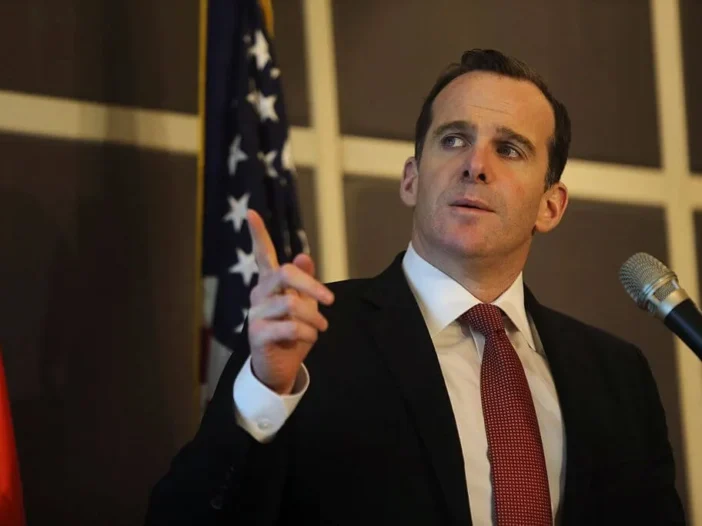
Brett McGurk has served at the highest levels of American national security under three consecutive presidents, George W. Bush, Barack Obama, and Joe Biden, a distinction that speaks to both his expertise and his rare reputation for non-partisanship in one of Washington’s most volatile policy arenas. Few foreign policy officials can claim a career spanning two decades, three administrations, a dramatic resignation, and a return to government under a different president. This complete Brett McGurk biography covers his early life, legal career, pivotal role in the Iraq War, his leadership of the global campaign to defeat ISIS, his tenure on the National Security Council, his estimated net worth, and what drives one of Washington’s most consequential national security figures.
Quick Facts About Brett McGurk
| Detail | Information |
| Full Name | Brett Howard McGurk |
| Nationality | American |
| Education | University of Michigan (BA), University of Michigan Law School (JD), Harvard Law School (LLM) |
| Occupation | National Security Expert, Former NSC Coordinator, Former Presidential Envoy, Author, Speaker |
| Known For | Special Presidential Envoy for the Global Coalition to Counter ISIL; NSC Coordinator for the Middle East and North Africa |
| Administrations Served | Bush (2003–2009), Obama (2013–2018), Biden (2021–2023) |
| Notable Resignation | December 2018, in protest of the Syria withdrawal decision |
| Estimated Net Worth | ~$3 million (2026 estimate) |
Early Life and Background
Brett McGurk was born and raised in the United States, growing up with an early interest in law, international affairs, and public service. Specific details about his birthdate and hometown are not part of the public record he has chosen to highlight, a reflection of his deliberate focus on his professional work rather than personal biography.
He pursued his undergraduate degree at the University of Michigan, where he developed a foundation in political science and international relations. He then earned his Juris Doctor (JD) from the University of Michigan Law School, one of the country’s most respected legal institutions.
McGurk’s academic preparation didn’t stop there. He went on to earn a Master of Laws (LLM) from Harvard Law School, one of the most prestigious legal credentials in the world. That combination, Michigan for depth, Harvard for elite legal training, positioned him precisely for the intersection of law and policy where his career would unfold.
The September 11, 2001 attacks proved to be a defining turning point. Like many of his generation in law and foreign policy, the attacks fundamentally redirected McGurk’s trajectory toward national security work. Within two years, he was inside the U.S. government at a senior level, helping shape the American response to the most consequential foreign policy crisis of the post-Cold War era.
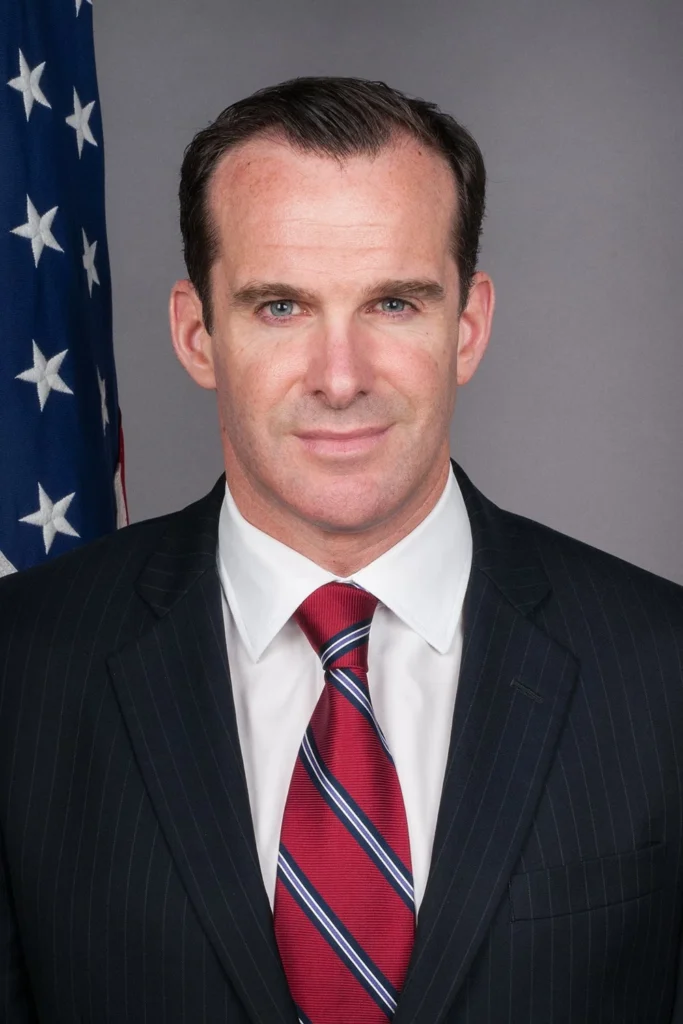
Career Beginnings, Law and the Road Into Government
McGurk entered government service in the early 2000s, joining the National Security Council staff during the George W. Bush administration. His legal background made him particularly suited for a role that required navigating the complex intersection of international law, sovereignty, and military policy.
His early government work focused on Iraq, the central theater of American foreign policy in that era. He quickly established himself as a serious, technically rigorous operator who could work across agencies and with foreign counterparts.
What set McGurk apart early was his willingness to engage directly with the most difficult political realities on the ground. He wasn’t a remote policy analyst, he travelled to Iraq repeatedly, building relationships with Iraqi political leaders that would prove critical in the years ahead.
Iraq War and the Bush Administration
McGurk’s most important work during the Bush years came in the final phase of the administration, when the United States needed to negotiate a legal framework for the continued presence of American troops in Iraq. The result was the Status of Forces Agreement (SOFA), signed in November 2008, which established the timeline for U.S. military withdrawal and defined the legal parameters under which American forces could operate.
McGurk was a central negotiator on that agreement, one of the most technically demanding diplomatic tasks of the Bush era. It required working with a sovereign Iraqi government that was deeply divided, navigating Iraqi constitutional law, and managing the politics of an agreement that both sides knew would shape the war’s end.
The SOFA set a December 31, 2011 deadline for the withdrawal of all U.S. combat forces from Iraq, a deadline that was ultimately met. McGurk’s fingerprints were on that history.
By the end of the Bush administration, he had established a reputation that would follow him for the next decade:
- Deep Iraq expertise, unmatched knowledge of the political landscape
- Legal precision, the ability to translate complex policy goals into binding agreements
- Interagency credibility, trusted by the Pentagon, State Department, and NSC simultaneously
Obama Administration, The Fight Against ISIS
After the Bush years, McGurk continued to work on Iraq-related issues, maintaining his expertise even as administrations changed. The rise of the Islamic State (ISIS/ISIL) in 2013–2014, which captured vast swaths of territory in Iraq and Syria and declared a “caliphate”, created an urgent need for exactly his kind of expertise.
In November 2015, President Barack Obama named McGurk as the U.S. Special Presidential Envoy for the Global Coalition to Counter ISIL.
The job was enormous in scope. McGurk was charged with coordinating a 68-nation coalition, aligning military operations with diplomatic objectives, and managing the relationships between actors with often conflicting interests, including Turkey, Saudi Arabia, the Kurdish forces (SDF/YPG), and the Iraqi government.
Territorial Defeat of ISIS
Under McGurk’s coordination, the coalition achieved what many had considered impossible in 2014: the near-total territorial defeat of ISIS. By late 2017 and into 2018, ISIS had lost approximately 98% of the territory it once held in Iraq and Syria, including its self-declared capital of Raqqa, Syria.
The military campaign worked in parallel with a diplomatic effort to maintain coalition unity, rebuild liberated cities, and prevent ISIS from reconstituting. McGurk was the civilian nerve center of that entire enterprise.
The Syria Resignation
In December 2018, President Donald Trump abruptly announced the withdrawal of U.S. forces from Syria via Twitter, catching the national security establishment by surprise. McGurk, who had just told reporters there was no timeline for withdrawal, resigned within days.
His resignation letter was pointed. He wrote that the U.S. had to “approach this complex challenge with a long-term strategy” and that he could not carry out a policy he believed undermined the coalition and emboldened ISIS remnants. His departure was widely covered and was accompanied by the resignation of Secretary of Defense James Mattis.
Biden Administration, NSC Coordinator for the Middle East
When President Joe Biden took office in January 2021, McGurk returned to government in one of the most senior Middle East roles in the U.S. national security architecture: Coordinator for the Middle East and North Africa on the National Security Council.
The position placed him at the center of every major U.S. engagement in the region:
- Israel-Gaza conflict, U.S. diplomatic efforts throughout the October 2023 Hamas attack and subsequent war
- Iran nuclear negotiations, U.S. strategy toward a potential return to the JCPOA framework
- Saudi Arabia relations, the Biden administration’s recalibration of the U.S.-Saudi relationship
- Syria and Iraq, continuing pressure on ISIS remnants and management of U.S. troop presence
- Lebanon and Hezbollah, regional escalation dynamics
McGurk became a particularly prominent figure in U.S. diplomacy during the Israel-Gaza war following the October 7, 2023 Hamas attack. He was involved in U.S. mediation efforts around ceasefire negotiations and hostage deals, traveling frequently to the region and to Arab capitals.
He departed the Biden administration in early 2024, returning to the private sector and academic sphere.
Brett McGurk as a Public Speaker
Following his departures from government, McGurk has become a sought-after voice on Middle East geopolitics, counterterrorism strategy, and the mechanics of building international coalitions. His combination of first-hand experience and policy depth makes him a rare commodity on the speaker circuit.
Core Speaking Topics Include:
- The ISIS war, strategy, coalition management, and lessons for future conflicts
- U.S. foreign policy in the Middle East across multiple administrations
- Iran, nuclear negotiations, regional influence, and deterrence strategy
- Israel, Gaza, and the future of U.S. engagement in the Levant
- Bipartisan national security leadership in a polarized era
- How American alliances are built, and what breaks them
Who Books Brett McGurk:
McGurk is typically engaged by:
- Foreign policy institutes and think tanks (Council on Foreign Relations, Brookings, Atlantic Council)
- Corporate risk conferences, global companies seeking geopolitical intelligence
- University international relations programs, top schools seeking experienced practitioners
- Government agencies and defense organizations, for leadership development forums
- Financial and intelligence community audiences, private briefings on regional risk
His appeal crosses ideological lines because his record does. Having served under both Republican and Democratic presidents, and having resigned on principle, he brings a credibility that purely partisan figures cannot match.
Brett McGurk Net Worth 2026
Brett McGurk’s estimated net worth in 2026 is approximately $3 million, based on publicly available information about his career trajectory and standard compensation ranges for senior officials in his field.
Primary Income Sources:
- Government service, Senior NSC and State Department positions carry GS-15 or Senior Executive Service salaries; meaningful but not wealth-building compensation
- Speaking fees, Top-tier foreign policy speakers typically command $20,000–$50,000 per engagement at major conferences and corporate events
- Consulting and advisory work, post-government, senior national security officials often advise financial institutions, defense contractors, and global corporations on geopolitical risk
- Academic appointments, Fellowships and visiting roles at institutions like Stanford, Georgetown, or Harvard’s Kennedy School provide income and platform
- Media and publishing, Paid commentary, articles, and potential book advances
McGurk has not disclosed his financial details publicly, so all estimates are approximations based on comparable in his peer group of former senior national security officials.
Personal Life
Brett McGurk keeps his personal life deliberately private, a common posture for national security professionals whose work has involved counterterrorism and adversarial foreign governments.
He is known within Washington policy circles as:
- Intensely prepared, colleagues consistently describe him as one of the most thoroughly briefed people in any room
- A practitioner, not a theorist, his credibility comes from field experience, not just academic analysis
- Genuinely non-partisan in operational context, he served three presidents from two parties and judged each situation on its merits
- Willing to resign on principle, a quality that set him apart in an era when many officials stayed in roles they privately opposed
His career has required sustained personal sacrifice, long deployments to conflict zones, extended time away from family, and the weight of decisions that directly affected lives on the ground. That reality colors the perspective he brings to both public speaking and policy analysis.
Brett McGurk Best Quotes
On the fight against ISIS:
“The territorial defeat of the caliphate didn’t happen by accident. It required a coalition of 68 nations, sustained over years, holding together despite enormous pressure. That’s what American leadership can look like.”
On his resignation:
“I worked to build the coalition. I believed in what we were doing. When the decision was made that I felt was wrong, abruptly, without consultation, I felt I had no choice but to resign.”
On the complexity of Middle East policy:
“There are no clean solutions in this region. Every choice has costs. The question is which costs are acceptable and which are not.”
On bipartisan national security:
“When you’re sitting across from an adversary or an ally, they don’t ask you which party you belong to. They want to know what America stands for and whether we’ll follow through.”
On the ISIS coalition:
“Sixty-eight countries. Different interests, different histories, different threat perceptions. Holding that together required constant attention, constant diplomacy, every single day.”
On American credibility:
“Allies watch whether we keep our word. Adversaries watch whether we keep our word. Once that credibility is gone, it’s extraordinarily hard to rebuild.”
On Syria withdrawal:
“I believed then and believe now that a hasty withdrawal without a plan empowers the people we’ve been fighting against.”
On the role of diplomacy:
“Military force can clear territory. Only diplomacy and governance can hold it.”
Frequently Asked Questions
Brett McGurk is an American national security expert and former senior government official who served under Presidents George W. Bush, Barack Obama, and Joe Biden. He is best known as the Special Presidential Envoy for the Global Coalition to Counter ISIL (2015–2018) and as the NSC Coordinator for the Middle East and North Africa (2021–2024). He holds law degrees from the University of Michigan and Harvard Law School.
McGurk served as the U.S. Special Presidential Envoy coordinating the 68-nation global coalition against ISIS from 2015 to 2018. Under his leadership, the coalition achieved the territorial defeat of ISIS, stripping the group of approximately 98% of the land it controlled in Iraq and Syria, including the fall of its self-declared capital, Raqqa, in October 2017. He was the principal civilian architect of that multinational military and diplomatic effort.
McGurk resigned in December 2018 after President Donald Trump announced an abrupt withdrawal of U.S. troops from Syria without consulting coalition partners or the national security team. McGurk had just told reporters publicly that there was no timeline for withdrawal. His resignation letter stated that the decision undermined the coalition and risked re-empowering ISIS. His departure coincided with the resignation of Secretary of Defense James Mattis.
Brett McGurk’s estimated net worth in 2026 is approximately $3 million. His wealth reflects a long government career at senior levels, supplemented by post-government income from speaking fees (typically $20,000–$50,000 per engagement), consulting with private sector clients on geopolitical risk, academic appointments, and media commentary. These figures are estimates; McGurk has not publicly disclosed personal financial details.
Brett McGurk speaks primarily on Middle East geopolitics, the ISIS war and its lessons, U.S. foreign policy across administrations, Iran’s regional strategy, the Israel-Gaza conflict, and building international coalitions under pressure. He is booked by foreign policy institutes, universities, corporate risk conferences, and government forums seeking a practitioner’s perspective from someone who operated at the highest levels of three consecutive presidential administrations.
Conclusion
The Brett McGurk biography is ultimately a story about sustained expertise, institutional trust, and the rarest kind of public service: a career that transcends the partisanship of any single administration. From negotiating the Iraq Status of Forces Agreement under President Bush, to coordinating the global defeat of ISIS under President Obama, to navigating the Israel-Gaza crisis under President Biden, McGurk has been at the center of America’s most consequential foreign policy decisions for more than two decades. His willingness to resign on principle in 2018, and to return to service three years later, speaks to a commitment to policy over politics that defines both his legacy and his ongoing relevance as a speaker, advisor, and public voice on national security.
Leave a Reply