
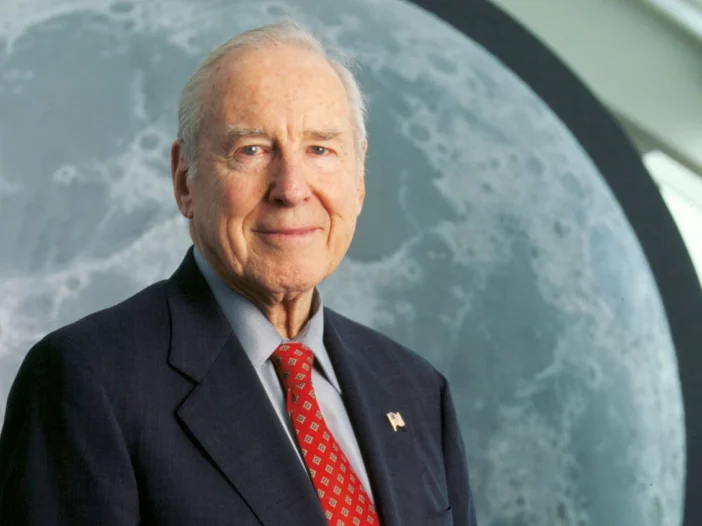
“Houston, we’ve had a problem.” On April 13, 1970, those seven words from Captain Jim Lovell triggered the most dramatic rescue operation in the history of human spaceflight. As commander of Apollo 13, Lovell watched an oxygen tank explode 200,000 miles from Earth, and then led his crew through four days of raw improvisation, ingenuity, and unshakeable calm to a safe splashdown in the Pacific Ocean.
Born March 25, 1928, in Cleveland, Ohio, Jim Lovell stands as one of only 24 humans ever to travel to the vicinity of the Moon. He is the only person in history to make that journey twice, without ever landing. This complete Jim Lovell biography covers his childhood, his four landmark NASA missions, his life after NASA, his speaking career, net worth, and the legacy of a man who turned catastrophe into triumph.
Quick Facts About Jim Lovell
| Category | Details |
| Date of Birth | March 25, 1928 |
| Birthplace | Cleveland, Ohio, USA |
| Nationality | American |
| Education | University of Wisconsin (1 year); United States Naval Academy, B.S. 1952 |
| Occupation | Retired U.S. Navy Captain; NASA Astronaut (Retired); Author; Public Speaker |
| Net Worth (est.) | $5 million |
| Spouse | Marilyn Gerlach Lovell (married 1952) |
| Children | 4 |
| Notable Missions | Gemini 7, Gemini 12, Apollo 8, Apollo 13 |
Early Life and Background
Jim Lovell grew up in Cleveland, Ohio, born to Blanche and James Lovell Sr. His father died in a car accident when Jim was just a young boy, leaving his mother to raise him largely on her own. That early experience of adversity, of having to make do with less and press forward anyway, shaped the stoic, resourceful character that would one day save three lives in outer space.
Lovell developed a passion for rocketry as a teenager, building his own small rockets and consuming every book he could find on aviation and aerospace. He enrolled at the University of Wisconsin for one year before earning a nomination to the prestigious United States Naval Academy in Annapolis, Maryland, where he graduated with a Bachelor of Science degree in 1952.
After graduation, Lovell pursued a career as a U.S. Navy aviator and test pilot. He logged over 3,000 hours of jet flight time, flying cutting-edge aircraft and developing the precise, unflappable decision-making skills that NASA would soon come looking for.
Career Beginnings
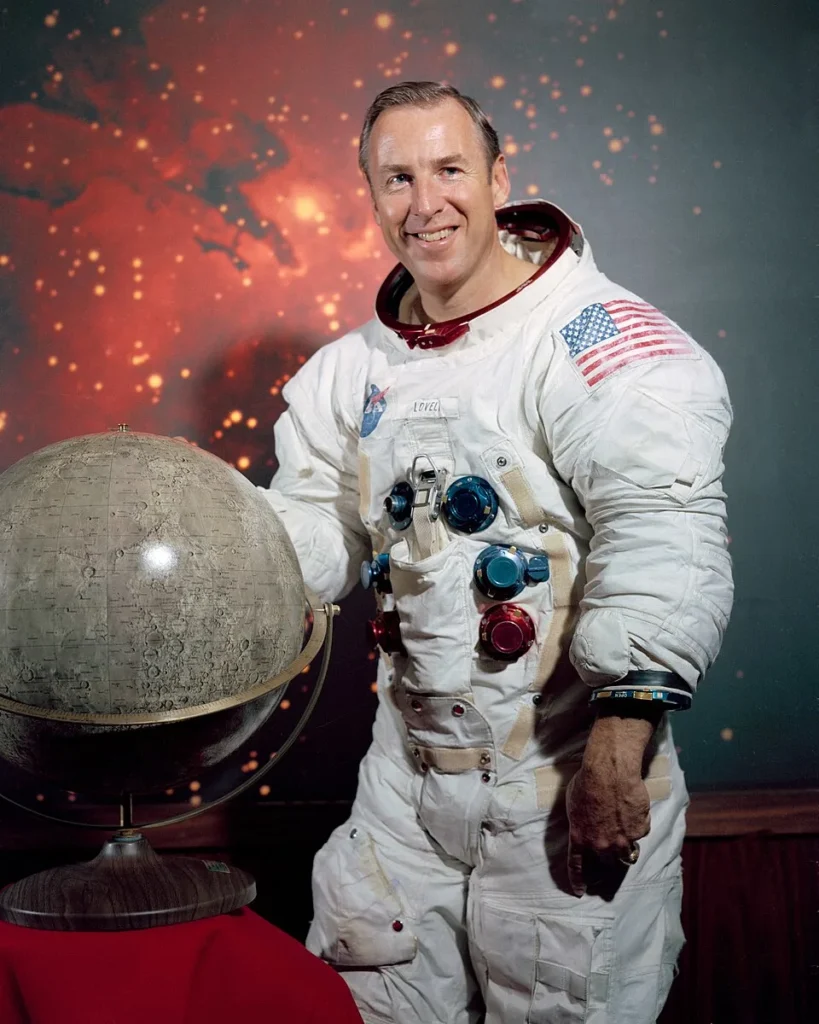
After the Naval Academy, Lovell applied to NASA’s astronaut program, and was initially rejected. His vision did not meet the original standards. Rather than accept defeat, he pursued treatment, corrected the issue, and reapplied in 1962. This time, he was selected as part of NASA’s Second Group of astronauts, the storied “New Nine,” alongside legends like Neil Armstrong, Pete Conrad, and John Young.
That tenacity, the refusal to be told no, became a defining thread of his entire career.
Major Career Highlights
Lovell flew on four spaceflights between 1965 and 1970, logging more time in space than any other astronaut of his era. Each mission pushed the boundaries of what was thought possible.
Gemini 7 (December 1965)
Paired with astronaut Frank Borman, Lovell launched aboard Gemini 7 on December 4, 1965, for what became the longest human spaceflight to that date. The crew spent 14 days in space, living in a capsule roughly the size of the front seat of a compact car, proving that humans could survive in microgravity long enough to reach the Moon and return.
Gemini 12 (November 1966)
Lovell flew again in November 1966 on Gemini 12, the final mission of the Gemini program, alongside astronaut Buzz Aldrin. The mission successfully completed critical spacewalk objectives and closed out the program that paved the way for Apollo.
Apollo 8 (December 1968)
Apollo 8 was a mission for the history books. On December 21, 1968, Lovell, Frank Borman, and William Anders became the first humans to leave Earth’s gravitational influence, travel to the Moon, and orbit it. On Christmas Eve, the crew broadcast a live television transmission from lunar orbit that reached an estimated one billion viewers around the world. Lovell, Borman, and Anders took turns reading from the Book of Genesis, a moment still regarded as one of the most profound broadcasts in the history of television.
The iconic “Earthrise” photograph, captured by Anders on this mission, changed the way humanity saw its home planet.
Apollo 13 (April 1970)
Nothing in spaceflight history compares to Apollo 13. Launched on April 11, 1970, the mission was intended to be the third lunar landing. Instead, it became the defining survival story of the Space Age.
Approximately 55 hours and 55 minutes into the mission, on the evening of April 13, an oxygen tank in the service module exploded. Lovell famously reported: “Houston, we’ve had a problem.” (The line was later rendered in the present tense, “have a problem”, for dramatic effect in the 1995 film.)
With the command module losing power and oxygen, Lovell, Jack Swigert, and Fred Haise abandoned it and crowded into the lunar module Aquarius, which was designed for two people on the Moon’s surface, not three people surviving a four-day journey home through the void of space.
What followed was an extraordinary demonstration of human problem-solving under pressure:
- The crew used the lunar module’s engine to alter their trajectory, looping around the Moon.
- Engineers at NASA ground control improvised a carbon dioxide filter fix using only materials aboard the spacecraft.
- The crew endured temperatures near freezing and operated on severely limited power.
- On April 17, 1970, the command module Odyssey splashed down in the Pacific Ocean, and all three astronauts were recovered safely.
NASA later called Apollo 13 a “successful failure”, a mission that never reached the Moon but demonstrated the unbreakable partnership between astronauts and ground teams when everything that could go wrong, did.
Jim Lovell as a Public Speaker
Jim Lovell is one of the most sought-after public speakers in America, and for obvious reasons. Few human beings on Earth can claim to have led a team through a life-or-death crisis at 200,000 miles from home and brought everyone back alive.
Speaking Topics
Lovell’s keynote presentations draw on his extraordinary career and resonate powerfully with corporate, academic, and government audiences. His core speaking themes include:
- Leadership under extreme pressure, decision-making when the stakes are absolute
- Crisis problem-solving, how Apollo 13’s team improvised solutions with the resources at hand
- Teamwork and trust, the human dynamics that made survival possible
- The full Apollo 13 story, a first-person account that no film or book can fully capture
- The future of human space exploration, the next chapter of humanity’s journey beyond Earth
- Innovation and resilience, applying space-age lessons to the modern business environment
Who Books Jim Lovell?
Lovell’s speaking audience spans industries and institutions. He is regularly booked for:
- Fortune 500 leadership conferences and executive summits
- University commencement ceremonies
- Aerospace and defense industry events
- Government and military leadership programs
- STEM education initiatives and school programs
His speaking fee is estimated in the range of $75,000–$150,000 per engagement, reflecting both his historical significance and his powerful on-stage presence. At 97 years old (as of 2025), Lovell remains one of the last living voices of the Apollo era, making every appearance a rare and irreplaceable experience.
Jim Lovell Net Worth 2026
Jim Lovell’s estimated net worth is approximately $5 million, built over a lifetime that extended far beyond his NASA salary.
His income streams have included:
- NASA career earnings as a U.S. Navy Captain and astronaut (retired at the rank of Captain after 21 years of Navy service)
- Book royalties from Lost Moon: The Perilous Voyage of Apollo 13 (1994), co-authored with journalist Jeffrey Kluger, which became a bestseller
- Premium speaking fees, estimated at $75,000–$150,000 per engagement
- Film-related income from the 1995 Universal Pictures film Apollo 13, directed by Ron Howard and starring Tom Hanks as Lovell, one of the highest-grossing films of that year
- Restaurant ownership, Lovell co-owns Lovell’s of Lake Forest, a well-regarded steakhouse in Lake Forest, Illinois, which has operated for decades as a local institution
While Lovell has never been a celebrity in the entertainment sense, his combination of speaking, publishing, hospitality, and brand value has produced a comfortable and well-deserved financial legacy.
Personal Life
Jim Lovell has been married to Marilyn Gerlach Lovell since 1952, a partnership spanning more than 73 years. Marilyn was the anchor of the family through the dangerous years of Lovell’s naval and NASA career, raising their four children while her husband orbited the Moon and fought to stay alive in a crippled spacecraft.
Their love story is itself remarkable. Marilyn’s experience during Apollo 13, living through those four terrifying days while the world watched, was portrayed movingly by actress Kathleen Quinlan in the 1995 film, earning Quinlan an Academy Award nomination.
The couple has lived for many years in Lake Forest, Illinois, a North Shore suburb of Chicago. In addition to their restaurant, the Lovells have remained quietly involved in their community.
Lovell has spoken often about his spiritual dimension, the experience of looking back at Earth from the Moon and seeing a fragile, luminous marble hanging in the blackness of space changed him. “I realized that I was looking at a very fragile planet,” he has said, a perspective that has informed his advocacy for science, education, and international cooperation in space ever since.
At 97, Jim Lovell is one of the last surviving astronauts of the Apollo era. He remains mentally sharp, publicly engaged, and deeply honored by the historical record he helped create.
Jim Lovell Best Quotes
1. On the Apollo 13 explosion:
“Houston, we’ve had a problem.” April 13, 1970, the transmission that launched the most complex rescue in history.
2. On the view of Earth from space:
“When I looked down and saw the Earth, I realized just how small and fragile it is.” Lovell has returned to this image repeatedly in interviews and speeches, a reminder of what Apollo gave us.
3. On Apollo 13’s odds of survival:
“There are people who make things happen, there are people who watch things happen, and there are people who wonder what happened. To be successful, you need to be a person who makes things happen.” One of Lovell’s most-quoted leadership insights, drawn from the Apollo 13 experience.
4. On the Moon:
“The Moon is a very quiet place. Quieter than any place you’ve ever been.” From a post-mission interview, describing the stark silence of lunar orbit.
5. On what Apollo meant:
“I think we’re going to the Moon because it’s in the nature of the human being to face challenges.” Lovell has used this sentiment to inspire generations of young scientists and engineers.
6. On survival:
“Space is a harsh mistress. She can kill you in a thousand ways. We got away.” Spoken during a public lecture, capturing the mortal reality that astronauts confronted on every mission.
7. On working with Tom Hanks:
“Tom did a great job. He captured the essence of the character. I told him, though, he’s a little better-looking than I am.” Said with Lovell’s characteristic dry humor at a 1995 film premiere.
8. On his legacy:
“I don’t look at it as just a mission. I look at it as the mission that defined what humans can do when they work together.” Lovell reflecting on Apollo 13 at a 50th anniversary event in 2020.
Frequently Asked Questions
Jim Lovell is a retired U.S. Navy Captain, NASA astronaut, author, and public speaker, born on March 25, 1928, in Cleveland, Ohio. He flew on four NASA missions, Gemini 7, Gemini 12, Apollo 8, and Apollo 13, logging more spaceflight time than any astronaut of his era. He is best known as the commander of Apollo 13, the 1970 mission that survived a catastrophic in-flight emergency. He is 97 years old as of 2025.
On April 13, 1970, an oxygen tank in the Apollo 13 service module exploded approximately 200,000 miles from Earth, crippling the spacecraft. Commander Jim Lovell, along with crewmates Jack Swigert and Fred Haise, abandoned the command module and sheltered in the lunar module. Using improvised repairs and the Moon’s gravity as a slingshot, the crew returned safely to Earth on April 17, 1970, a rescue NASA called a “successful failure.”
No. Despite traveling to the Moon twice, once on Apollo 8 (orbiting in December 1968) and once as commander of Apollo 13 (April 1970), Jim Lovell never landed on the lunar surface. The Apollo 13 mission was aborted after the oxygen tank explosion. He remains the only person in history to have traveled to the Moon twice without landing, a distinction both remarkable and bittersweet.
Jim Lovell’s net worth is estimated at approximately $5 million. His wealth comes from multiple sources: his long U.S. Navy and NASA career, royalties from his bestselling book Lost Moon (1994), premium public speaking fees (estimated $75,000–$150,000 per event), income related to the 1995 Universal Pictures film Apollo 13, and his ownership stake in Lovell’s of Lake Forest, a steakhouse restaurant in Lake Forest, Illinois.
Jim Lovell is a premium keynote speaker whose presentations focus on leadership under pressure, crisis problem-solving, and the human factors behind Apollo 13’s survival. He also speaks about teamwork, resilience, the future of space exploration, and the importance of STEM education. His events include Fortune 500 leadership summits, university commencements, and aerospace conferences. His speaking fee is estimated between $75,000 and $150,000 per engagement.
Conclusion
Few figures in American history embody the marriage of courage, competence, and grace under pressure quite like Captain Jim Lovell. From a childhood marked by loss in Cleveland to the cockpit of Apollo 13, orbiting a Moon he would never touch, managing a crisis no training manual could have fully anticipated, his life has been one of extraordinary service to his country and to humanity’s larger ambition.
This Jim Lovell biography is a testament to what one person, shaped by the right values at the right moment, can accomplish. He did not just survive Apollo 13. He led it home. That story, of ingenuity, teamwork, and the refusal to quit, is why boardrooms, universities, and conference halls still want to hear from him more than 55 years later.
Leave a Reply