
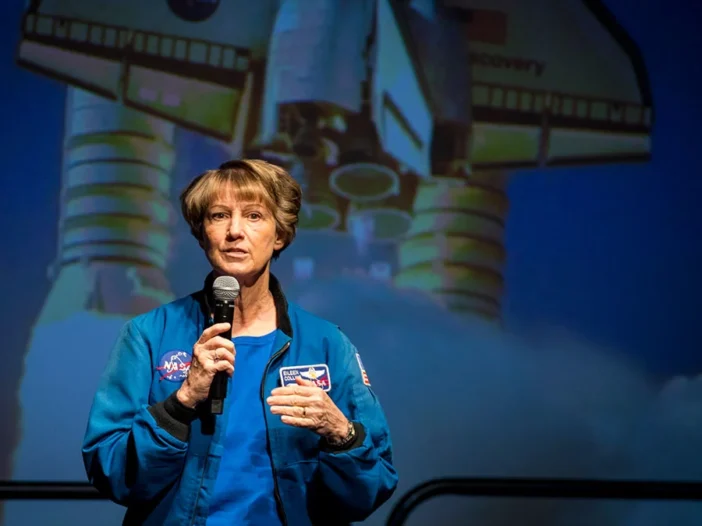
In 1999, Eileen Collins made history that reverberated far beyond NASA, she became the first woman ever to command a United States Space Shuttle, launching aboard Columbia on mission STS-93 to deploy the Chandra X-Ray Observatory. The announcement was made at the White House by President Bill Clinton and First Lady Hillary Clinton, a rare recognition of just how seismic the moment truly was. Born November 19, 1956, in Elmira, New York, Collins grew up dreaming of the sky at a time when most cockpit doors were closed to women. She didn’t just push those doors open, she flew through them and into orbit. This complete Eileen Collins biography covers her childhood, Air Force career, four NASA missions, speaking work, personal life, and lasting legacy as one of America’s greatest astronauts.
Quick Facts About Eileen Collins
| Detail | Information |
| Date of Birth | November 19, 1956 |
| Birthplace | Elmira, New York |
| Nationality | American |
| Education | BS Mathematics & Economics, Syracuse University (1978); MS Operations Research, Stanford University; MA Space Systems Management, Webster University; Air Force Institute of Technology |
| Estimated Net Worth | ~$5 million |
| Spouse / Partner | Pat Youngs (married 1987) |
| Children | 2 |
| Occupation | Retired NASA Astronaut, USAF Colonel (Ret.), Public Speaker, Aerospace Consultant |
Early Life and Background
Eileen Collins grew up in Elmira, New York, a small city with a deep aviation heritage, it’s home to the National Soaring Museum and one of the country’s premier glider-flying communities. For young Eileen, the sight of planes overhead wasn’t background noise; it was a calling.
Her family background was modest, and Collins took nothing for granted. By age 19, she was working part-time jobs specifically to save up for flying lessons, a detail that says everything about her drive. She didn’t wait for opportunity. She paid for it herself.
Collins attended Syracuse University, earning a Bachelor of Science in Mathematics and Economics in 1978. She went on to earn a Master of Science in Operations Research from Stanford University and a Master of Arts in Space Systems Management from Webster University. Her academic record at the Air Force Institute of Technology rounded out one of the most impressive educational profiles in the astronaut corps.
Her early years set the pattern: identify the goal, work for it without excuses, and outperform expectations.
Air Force Career
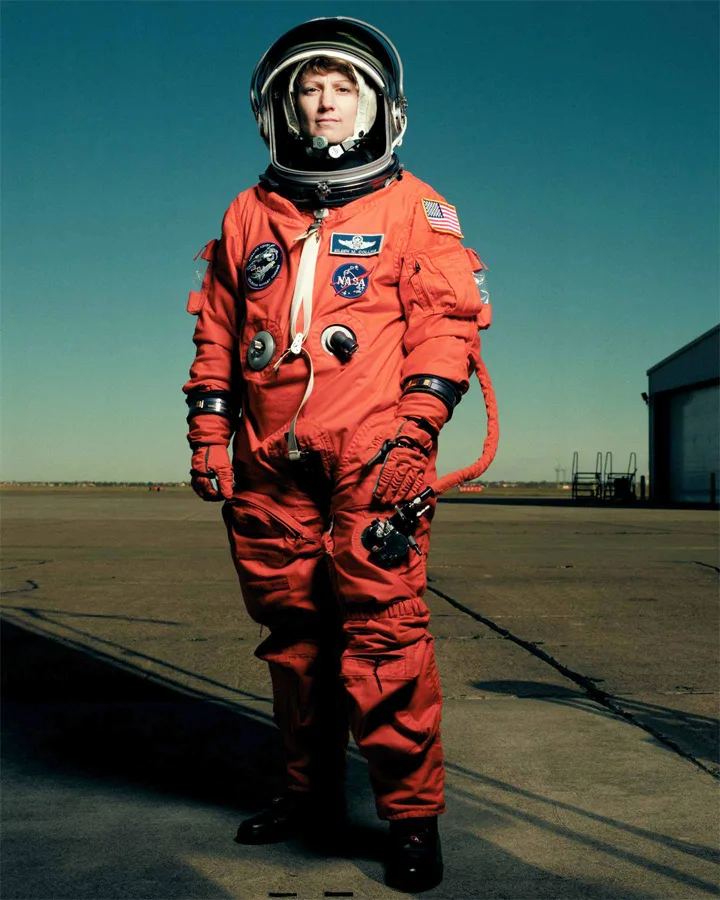
After graduating from Syracuse, Collins entered the U.S. Air Force, and immediately began rewriting what women could do in uniform.
In 1979, she became one of the Air Force’s first female flight instructors. She was among the first four women admitted to Air Force Undergraduate Pilot Training, a program that had been entirely male until the late 1970s. These weren’t symbolic milestones. Collins was logging real flight hours in a world that hadn’t yet decided women belonged there.
Her Air Force record is extraordinary:
- Flew the C-141 Starlifter as aircraft commander
- Participated in operational missions including the 1983 Grenada invasion
- Graduated from the Air Force Test Pilot School, again among the first women to do so
- Accumulated 6,751 flight hours across 30 different aircraft types
- Achieved the rank of Colonel in the United States Air Force
That flight-hour count alone, 6,751 hours in 30 aircraft, tells you everything about the caliber of aviator NASA recruited in 1990.
NASA Selection and Early Roles
Eileen Collins was selected as a NASA astronaut in 1990, joining a class that would reshape the agency’s human spaceflight program through the decade.
Before her first flight, Collins served in critical behind-the-scenes roles that defined mission success:
- Spacecraft Communicator (CAPCOM), the voice between Mission Control and crews in orbit
- Branch Chief positions within the astronaut office
- Technical assignments supporting Shuttle program operations
These roles weren’t glamorous, but they were essential. Collins spent years understanding the machine from the inside out before she ever strapped herself into it.
Four Historic Space Shuttle Missions
STS-63 Discovery, February 1995: First Woman to Pilot a Space Shuttle
On February 3, 1995, Eileen Collins became the first woman in history to pilot a Space Shuttle when Discovery lifted off on mission STS-63.
The mission was historic on multiple fronts. It was the first joint U.S.-Russian Space Shuttle program flight, involving a rendezvous with the Mir Space Station, a docking approach that required extraordinary precision and signaled the beginning of a new era of international cooperation in space.
Collins handled the approach to Mir with the kind of calm command that would come to define her reputation.
STS-84 Atlantis, May 1997: Shuttle-Mir Docking
Collins returned to orbit aboard Atlantis on mission STS-84 in May 1997, this time as part of the second Shuttle-Mir docking mission. The mission continued building the U.S.-Russia partnership that would eventually evolve into International Space Station operations.
Her performance across back-to-back high-stakes missions cemented her status as one of NASA’s most trusted pilots.
STS-93 Columbia, July 1999: First Female Space Shuttle Commander
July 23, 1999 is the date etched into NASA history. Collins took the commander’s seat of Space Shuttle Columbia for mission STS-93, becoming the first woman ever to command a United States spacecraft.
The mission’s primary payload was the Chandra X-Ray Observatory, one of NASA’s four Great Observatories and to this day one of the most powerful X-ray telescopes ever deployed. Collins and her crew delivered it flawlessly to orbit, where it continues returning data about black holes, supernovae, and the structure of the universe.
The mission carried enormous symbolic weight. President Clinton announced Collins’s command at a White House event, a measure of how far beyond NASA this moment reached.
STS-114 Discovery, July 2005: Return to Flight
Perhaps the most pressure-laden mission of Collins’s career came six years after her historic command. In the wake of the Space Shuttle Columbia disaster of February 2003, which killed all seven crew members, NASA grounded the fleet for more than two years.
Collins was chosen to lead STS-114, the Return to Flight mission, commanding Discovery back to orbit on July 26, 2005. Every engineer, every technician, every family member of a NASA employee held their breath.
She brought her crew home safely. Total spaceflight time across all four missions: 872 hours in space.
Eileen Collins as a Public Speaker
After retiring from NASA in 2006, Collins transitioned into a second chapter as one of the most sought-after voices in aerospace leadership and women’s achievement.
Her speaking engagements span industries and audiences. Organizations that book Collins typically include:
- Aerospace and defense companies seeking authentic leadership voices
- STEM education conferences and university programs
- Women’s leadership summits and diversity in business events
- Corporate keynote events focused on performance under pressure
- Government and military organizations honoring innovation and service
Collins’s core speaking topics include:
- Leadership under extreme uncertainty, from Shuttle cockpits to boardrooms
- The history of women in aviation and space, personal and institutional
- Breaking institutional barriers, her lived experience across decades
- Decision-making under pressure, the cognitive and emotional dimensions
- The legacy of the Space Shuttle program, what it built, what it cost, what it meant
Her credibility is unimpeachable. Collins doesn’t talk about overcoming obstacles in the abstract, she flew four Space Shuttle missions carrying those obstacles as extra weight.
Eileen Collins Net Worth 2026
Eileen Collins’s estimated net worth in 2026 is approximately $5 million, built across several income streams over a remarkable career.
Her wealth reflects decades of service and expertise:
- NASA astronaut salary and federal retirement benefits accumulated across a 16-year career with the agency
- U.S. Air Force Colonel pension from her distinguished military service
- Public speaking fees, top astronaut speakers command fees in the range of $30,000–$75,000 per appearance
- Aerospace consulting and advisory board positions with companies operating in the space sector
- Honorary degrees and recognition programs that accompany her status as a pioneer
Collins is not known for flashy wealth. Her public profile reflects someone who built a career on substance rather than celebrity, and whose financial security is a quiet reward for decades of extraordinary service.
Personal Life
Eileen Collins married Pat Youngs, a retired U.S. Air Force pilot, in 1987. The couple has two children. Their shared military aviation background gives their household a perspective on service and risk that few families can claim.
Collins was inducted into the National Women’s Hall of Fame, a recognition that places her alongside the most consequential women in American history. She has received numerous honorary degrees from universities across the country.
She remains actively engaged in the aerospace community as of 2026, speaking, consulting, and serving as a mentor figure for the next generation of women entering aviation and space careers.
Her lifestyle reflects her values: grounded, purposeful, and oriented toward contribution rather than recognition. Collins has spoken openly about faith, family, and the responsibility that comes with being a role model, a role she didn’t seek but has embraced with characteristic professionalism.
Eileen Collins Best Quotes
On becoming the first female commander:
“I didn’t set out to be the first woman to do anything. I set out to be the best pilot I could be.” Collins has consistently deflected the historic framing back to craft and preparation, a recurring theme in her public remarks.
On the Columbia Return to Flight mission:
“Every mission carries risk. Our job is to understand the risk, mitigate what we can, and then fly.” Said in the lead-up to STS-114, when the weight of the Columbia disaster hung over every pre-launch decision.
On women in aviation:
“When I started, there were no women fighter pilots, no women test pilots. Today it’s normal. That’s progress, and it happened because women showed up and did the work.” From a keynote at a women in aerospace conference.
On leadership:
“The best leaders I’ve known were also the best listeners. In space, the person who thinks they know everything is the most dangerous person in the room.” A central theme in her corporate speaking engagements.
On the Chandra deployment:
“Deploying Chandra was one of the proudest moments of my career, not because I was commander, but because the whole crew executed perfectly.” Collins is known for consistently redirecting credit to her teams.
On young women in STEM:
“Don’t wait for someone to open the door. Learn to fly, and you won’t need anyone to open it.” Frequently cited in educational settings and commencement addresses.
On the Space Shuttle program:
“The Shuttle was imperfect. It was also one of the greatest engineering achievements in human history. Both things are true.” Collins has spoken honestly about the program’s tragedies alongside its triumphs.
On risk:
“Risk is not the enemy. Ignorance of risk is the enemy.” A concise formulation she returns to frequently in leadership contexts.
Frequently Asked Questions
Eileen Collins is a retired NASA astronaut and U.S. Air Force Colonel born on November 19, 1956, in Elmira, New York. She is best known as the first woman to pilot and the first woman to command a United States Space Shuttle. Collins completed four missions and logged 872 hours in space before retiring from NASA in 2006. She is now an active public speaker and aerospace consultant.
Yes. On July 23, 1999, Eileen Collins became the first woman in history to command a U.S. Space Shuttle when she led mission STS-93 aboard Columbia. The crew successfully deployed the Chandra X-Ray Observatory. President Bill Clinton announced her historic command at the White House, underscoring the national significance of her role. No woman had held a Shuttle commander’s seat before Collins.
Eileen Collins flew four Space Shuttle missions: STS-63 (1995), STS-84 (1997), STS-93 (1999), and STS-114 (2005). She served as pilot on the first two missions and as commander on the final two. Across all four flights, she accumulated a total of 872 hours in space, approximately 36 days off the planet.
Eileen Collins’s estimated net worth is approximately $5 million as of 2026. Her wealth comes from a combination of her NASA and Air Force careers, federal retirement benefits, speaking fees (top astronaut speakers typically earn $30,000–$75,000 per engagement), and aerospace consulting. Collins is not publicly known for major business ventures or endorsements; her wealth reflects sustained professional achievement over several decades.
Eileen Collins speaks primarily on leadership under pressure, breaking institutional barriers, women in aviation and space history, and decision-making in high-stakes environments. She is frequently booked for aerospace industry events, STEM education conferences, women’s leadership summits, military organizations, and corporate keynote events. Her firsthand experience commanding four Space Shuttle missions gives her speaking an authority that is genuinely rare.
Conclusion
The Eileen Collins biography is ultimately a story about what happens when talent meets relentless preparation, and when one person’s ambition quietly reshapes what’s possible for everyone who comes after. From saving up for flying lessons as a teenager in Elmira, New York, to commanding humanity’s most complex flying machine, Collins built her legacy one disciplined choice at a time. She flew 4 missions, logged 872 hours in space, commanded the historic Return to Flight after Columbia, and spent two decades proving that the ceiling was never the point, the stars were. Whether you’re a student, a professional, or an organization looking for a keynote that will leave your audience changed, Eileen Collins delivers.
Leave a Reply