

On October 12, 2000, eleven months before September 11, al-Qaeda detonated a bomb alongside the USS Cole in the port of Aden, Yemen, killing 17 American sailors and wounding 37 more. At the helm of the Cole was Commander Kirk Lippold, a United States Naval Academy graduate who led his crew through one of the most devastating terrorist attacks in American military history, and, through sheer leadership and seamanship, kept the ship from sinking.
This Kirk Lippold biography tells the full story: a 26-year Navy career, an investigation that shadowed his promotion, a candid book that set the record straight, and a second act as one of America’s most sought-after voices on leadership under fire. Whether you know him from the headlines or are discovering him for the first time, Lippold’s life is a case study in how character is forged under pressure.
Quick Facts About Kirk Lippold
| Detail | Information |
| Date of Birth | April 29, 1959 |
| Birthplace | United States |
| Nationality | American |
| Education | United States Naval Academy (Class of 1981); Army Command and General Staff College (1994); Joint Forces Staff College (2001) |
| Occupation | Retired U.S. Navy Commander, Author, Speaker, President of Lippold Strategies LLC, USNA Adjunct Professor |
| Notable Work | Commanding Officer, USS Cole (DDG-67); Author, Front Burner (2012) |
| Net Worth | Estimated $2 million |
| Spouse/Partner | Not publicly disclosed |
| Based In | Virginia |
Early Life and Background
Kirk Lippold was born on April 29, 1959, and came of age during the final years of the Cold War, a period that shaped a generation of American military officers who understood that service meant more than ceremony.
He pursued a rigorous academic and physical path that led him to the United States Naval Academy in Annapolis, Maryland, where he graduated with the Class of 1981. The Naval Academy’s demanding culture, built on honor, courage, and commitment, laid the philosophical foundation for everything Lippold would later face.
His early years in the Navy were defined by a willingness to serve in demanding billets, learn the mechanics of warships, and absorb the culture of a fighting force still operating under Cold War tensions. Those formative years would ultimately shape a commander who knew exactly what his crew needed when the world was watching.
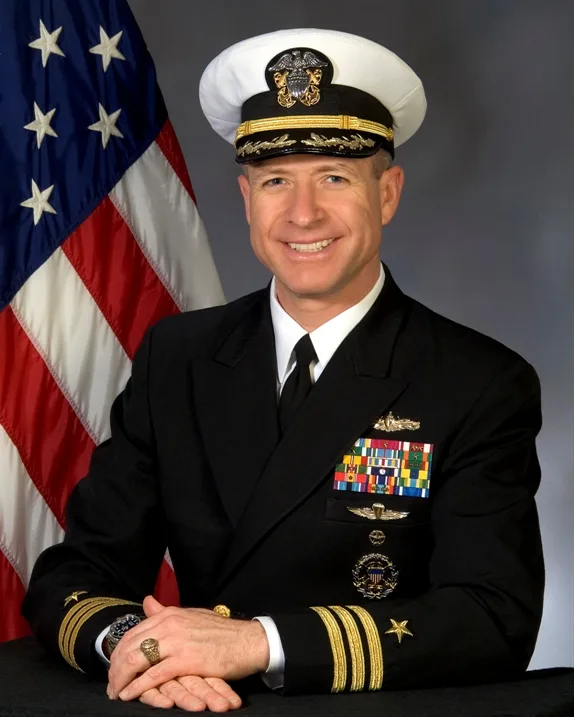
Career Beginnings, 26 Years in the United States Navy
Lippold’s naval career unfolded across three decades and multiple platforms, each assignment adding a layer of operational and strategic experience.
He began as a Division Officer aboard USS Yorktown (CG-48), learning the fundamentals of surface warfare and shipboard leadership from the deck plates up. He then served as Operations Officer on the commissioning crew of USS Arleigh Burke (DDG-51) , the first ship of what became the Navy’s most successful destroyer class , giving him early exposure to cutting-edge naval technology.
His career progression included:
- Executive Officer, USS Shiloh (CG-67), one step below commanding officer, where leadership under pressure became daily practice
- Administrative Aide to the Secretary of the Navy, a high-visibility Pentagon assignment requiring political acuity alongside military expertise
- Joint Chiefs of Staff, where he helped craft detainee policy in the critical months following September 11, 2001
- Army Command and General Staff College (1994) and Joint Forces Staff College (2001), elite joint professional military education programs
He assumed command of USS Cole (DDG-67) on June 25, 1999, stepping into one of the most coveted jobs in surface warfare: commanding officer of a front-line guided-missile destroyer.
The USS Cole Attack, October 12, 2000
On the morning of October 12, 2000, USS Cole was conducting a routine refueling stop in the port of Aden, Yemen, as part of a deployment to the Persian Gulf. It was a scheduled, unremarkable stop, until it wasn’t.
At approximately 11:18 a.m. local time, two al-Qaeda operatives guided a small fiberglass boat packed with C-4 plastic explosive alongside the Cole’s port side and detonated it. The explosion tore a 40-by-40-foot hole in the hull of the 8,600-ton Arleigh Burke-class destroyer, killing 17 sailors instantly and wounding 37 others. The blast buckled interior decks and flooded critical compartments.
What happened next defined Kirk Lippold’s legacy. Rather than losing the ship, Lippold and his crew executed extraordinary damage control, keeping Cole afloat against enormous odds. Sailors plugged holes with mattresses and their own clothing, formed human chains, and maintained discipline under conditions of chaos and grief.
The attack was the deadliest assault on a U.S. naval vessel since the 1987 USS Stark incident and was later recognized as the most brazen al-Qaeda strike on American interests before September 11, 2001, a direct rehearsal for the attacks that would follow less than a year later.
USS Cole was eventually transported back to the United States aboard a heavy-lift ship and underwent 14 months of repairs before returning to active duty. The ship remains in service today.
Aftermath, Investigation, Controversy, and Retirement
The attack triggered one of the most consequential military investigations of the pre-9/11 era, and the outcome would follow Lippold for years.
A Naval investigation acknowledged the professionalism of Lippold’s crew while also concluding that available force protection measures had not been fully utilized before the attack. The findings were nuanced, but the political fallout was not.
A U.S. senator blocked Lippold’s promotion to captain, a move that generated significant controversy within the military community. Critics argued that Lippold was being held responsible for systemic intelligence and policy failures that extended far beyond one ship’s commanding officer. Supporters noted that Lippold had acted with exceptional leadership after the attack and that his crew’s discipline had saved the ship and dozens of lives.
Lippold retired from the United States Navy in May 2007 at the rank of Commander, a career cut short by politics rather than performance, in the view of many naval observers.
His retirement was not a retreat. It was the beginning of a new mission.
Author, Front Burner: Al Qaeda’s Attack on the USS Cole
In 2012, Lippold published Front Burner: Al Qaeda’s Attack on the USS Cole , the definitive first-person account of the bombing, its aftermath, and its lasting implications for the war on terror.
Front Burner was notable for several reasons:
- It provided the commanding officer’s ground-level perspective on an attack that had been extensively covered from Washington but rarely from the ship itself
- Lippold addressed the investigation and its controversies directly and without self-pity, offering a candid examination of what he could and could not control
- The book contextualized the Cole bombing within the broader failure of American counter-terrorism policy in the late 1990s, drawing a direct line from Aden to lower Manhattan
- It established Lippold as a serious national security thinker, not merely a survivor
Front Burner received strong reviews from military audiences and national security circles, and remains a reference point in discussions of pre-9/11 intelligence failures and military readiness.
Kirk Lippold as a Public Speaker
Following his retirement, Lippold built a high-demand speaking career through the Keppler Speakers bureau, one of the country’s leading representation firms for military and political thought leaders.
His speaking topics draw directly from lived experience, not management theory or business school case studies:
- Leadership under fire, decision-making when lives are on the line
- Crisis management and damage control, literal and metaphorical
- The USS Cole story, what happened, what it revealed, and what it means today
- Global security threats, the evolution of terrorism and asymmetric warfare
- Preparation, adaptability, and resilience in high-stakes environments
- Ethics in leadership, built from his work as a USNA professor
Lippold has briefed more than 6,000 military officers and 2,000 law enforcement officers on threat awareness and crisis response. His civilian client roster spans Fortune 500 companies, major financial institutions, and government agencies that require speakers who have genuinely operated under pressure, not merely studied it.
He currently serves as an Adjunct Professor at the United States Naval Academy, teaching Leadership and Ethics, a role that places him in front of the next generation of American military officers.
Keppler Speakers fee range: $10,001–$20,000 per engagement.
His appeal to corporate and institutional audiences stems from a simple truth: Lippold never turns the USS Cole into a motivational parable. He speaks about what actually happened, what was hard, what failed, and what succeeded. For organizations navigating genuine risk, that credibility is irreplaceable.
Kirk Lippold Net Worth 2026
Kirk Lippold’s estimated net worth is approximately $2 million, built across multiple income streams following his naval retirement.
His primary revenue sources include:
- Lippold Strategies LLC, his Virginia-based consulting firm advising on national security, leadership, and organizational crisis preparedness
- Professional speaking fees via Keppler Speakers: $10,001–$20,000 per engagement
- Front Burner book royalties and related ancillary rights
- USNA adjunct professorship compensation
- Media appearances and national security commentary
Unlike many retired military figures who leverage rank alone, Lippold has built a business around substantive expertise, operational, analytical, and educational. His Lippold Strategies consulting practice positions him as an advisor to organizations that need to think seriously about crisis readiness, not just check a box.
His net worth reflects a deliberate second career rather than a passive retirement, a pattern consistent with the same discipline that kept USS Cole afloat in October 2000.
Personal Life
Kirk Lippold is based in Virginia, the state that serves as home to much of the U.S. defense and national security community. He maintains a relatively private personal life, a deliberate choice that reflects the culture of the military community from which he came.
What is publicly known paints a picture consistent with his professional persona:
- Faith and service appear as consistent themes in his public statements and writing
- He is known among peers and clients as someone who translates genuine combat experience into practical guidance, without the clichés that often dilute military-to-business messaging
- His USNA professorship suggests a genuine investment in mentorship and the long-term health of military leadership culture
- He is widely regarded in national security circles as someone who speaks hard truths without agenda, a reputation built partly through the candor of Front Burner
For a man at the center of one of the defining events of the pre-9/11 era, Kirk Lippold has chosen depth over celebrity.
Kirk Lippold Best Quotes
On the moment of the attack:
“There was no warning, just a massive explosion that rippled through the ship. My job in that moment was to keep my crew alive and keep Cole afloat.”
On leadership in crisis:
“Leadership isn’t what you do when things go well. It’s what you do in the first thirty seconds after everything falls apart.”
On the failure of intelligence policy:
“The Cole attack was a strategic warning that went unanswered. The men and women who died deserved better from their government.”
On the sailors of USS Cole:
“The crew of the Cole were extraordinary Americans. They performed under conditions that would have broken most people, and they never stopped fighting for each other.”
On speaking to business audiences:
“Every organization I walk into faces some version of what my crew faced, degraded conditions, incomplete information, and a decision that has to be made right now.”
On his post-Navy mission:
“I didn’t retire. I redirected. The mission changed, but the obligation to lead well never does.”
On the USS Cole’s legacy:
“That ship came home. That matters. Seventeen families didn’t get their sailors back, but the Cole came home, because of what her crew chose to do in the worst moment of their lives.”
On accountability:
“I’ve never asked for absolution. I’ve only asked that people understand the full picture before they render judgment, on me, on my crew, or on the decisions made in Washington.”
Frequently Asked Questions
Kirk Lippold is a retired U.S. Navy Commander best known as the commanding officer of USS Cole (DDG-67) during the October 12, 2000 al-Qaeda bombing in Aden, Yemen, that killed 17 sailors. He is also the author of Front Burner (2012), president of Lippold Strategies LLC, an adjunct professor at the United States Naval Academy, and a professional speaker on leadership, crisis management, and national security.
On October 12, 2000, USS Cole was refueling in the port of Aden, Yemen, when al-Qaeda operatives detonated a bomb from a small boat alongside the ship’s hull. The explosion killed 17 American sailors, wounded 37, and blew a 40-by-40-foot hole in the destroyer’s hull. Commander Lippold and his crew’s damage control efforts kept the ship afloat. The Cole was repaired and returned to active service.
A Naval investigation found that available force protection measures were not fully utilized before the attack, though Lippold’s response after the bombing was widely praised. A U.S. senator subsequently blocked his promotion to captain, a controversial decision that many in the military community viewed as unfair given the systemic intelligence failures involved. Lippold retired as a Commander in May 2007.
Kirk Lippold’s net worth is estimated at approximately $2 million, derived from multiple sources: his Lippold Strategies LLC consulting firm, professional speaking fees of $10,001–$20,000 per engagement through Keppler Speakers, royalties from Front Burner, and his role as an adjunct professor at the United States Naval Academy. His wealth reflects a productive post-military career rather than a passive retirement.
Kirk Lippold speaks on leadership under fire, crisis management, and national security, drawing directly from his experience commanding USS Cole during the 2000 al-Qaeda bombing. He addresses Fortune 500 companies, financial institutions, and government agencies, and has briefed more than 6,000 military officers and 2,000 law enforcement officers. His speaking fee through Keppler Speakers ranges from $10,001 to $20,000 per engagement.
Conclusion
The Kirk Lippold biography is ultimately a story about what human beings can do when circumstances strip away every comfort and leave only character. From the Naval Academy Class of 1981 through 26 years of naval service, the nightmare of October 12, 2000, the fight to keep his crew’s sacrifice from being forgotten, and a second career built on genuine expertise, Kirk Lippold has never taken the easy path.
He lost 17 sailors. He kept his ship. He told the truth in a book when silence might have been easier. He teaches the next generation of Navy officers and advises organizations that need to think seriously about what leadership actually requires.
His story is essential reading for anyone who wants to understand American military history, the origins of the war on terror, or what it means to lead when failure is not an option.
Leave a Reply