
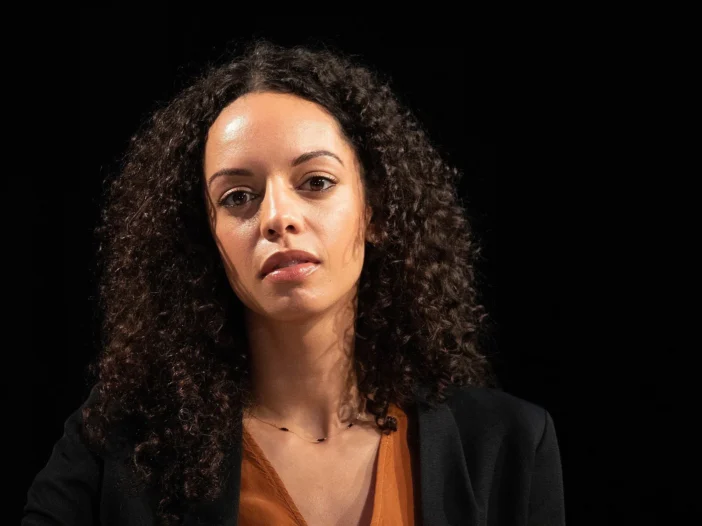
When Caitlin Dickerson won the 2023 Pulitzer Prize for Public Interest Journalism, it was the culmination of an 18-month investigation that rewrote what America thought it knew about one of the most polarizing policies in recent history. Her landmark piece for The Atlantic, “Inside the Chaos of the Trump Administration’s Child-Separation Policy”, revealed in exhaustive detail how the administration’s so-called “zero tolerance” approach was more deliberate in its design, more chaotic in its execution, and more damaging to thousands of children than official accounts had acknowledged.
This is the complete Caitlin Dickerson biography, covering her early career, her years at NPR and The New York Times, her move to The Atlantic, the investigation that changed immigration journalism, her work as a public speaker, and the personal values that drive one of the most important reporters in America today.
Quick Facts About Caitlin Dickerson
| Category | Details |
| Nationality | American |
| Education | Georgetown University |
| Occupation | Staff Writer, The Atlantic; Pulitzer Prize Winner; Public Speaker |
| Known For | Family separation investigation; Pulitzer Prize 2023; immigration journalism |
| Award | Pulitzer Prize for Public Interest Journalism (2023) |
| Employer | The Atlantic |
| Previous Employers | NPR; The New York Times |
| Specialization | Immigration, border policy, asylum, human rights |
| Net Worth (Est.) | ~$1.5–$2 million |
| Based In | East Coast, USA |
Early Life and Background
Caitlin Dickerson grew up with what her reporting consistently reflects: a belief that the most important stories are the ones told from the ground up, from the lives of individual people caught inside systems larger than themselves. While she guards the details of her personal life carefully, a deliberate choice for a journalist whose work has placed her in politically charged territory, her academic and professional formation is well documented.
Dickerson attended Georgetown University, one of the country’s most prestigious institutions for journalism, international affairs, and public policy. Georgetown’s environment, proximate to the machinery of federal government, steeped in a tradition of civic and ethical inquiry, helped shape the kind of reporter she would become: one who combines rigorous document-based reporting with genuine human empathy.
Her formative intellectual interests centered on policy, law, and the intersection between government power and individual lives. Those interests would find their fullest expression in immigration journalism, a beat that demands equal facility with legal complexity, political history, and deeply personal human narrative.
Career Beginnings: NPR and the Immigration Beat
Dickerson began her journalism career at NPR, where she covered immigration for one of the most widely listened-to news organizations in the United States. Working in public radio gave her a distinct skill set: the ability to take complicated policy questions and render them accessible, urgent, and human for a mass audience.
At NPR, she developed the source relationships and institutional knowledge that would define her career. Immigration is a beat that rewards patience, laws change slowly, bureaucracies resist transparency, and the people most affected are often the most difficult to reach. Dickerson proved willing to do the slow, unglamorous work that great immigration reporting requires.
Her reputation grew steadily. By the time she moved to The New York Times, she was already recognized inside journalism circles as one of the most thorough and humane reporters working the immigration beat in America.
Career at The New York Times
At The New York Times, Dickerson’s profile expanded significantly. She covered immigration during one of the most turbulent periods in the beat’s modern history, the years spanning the Obama administration’s deportation policies, the rise of DACA, shifting asylum standards, and the early years of the Trump administration’s hardline approach to border enforcement.
Her work at The Times demonstrated several qualities that distinguish the best immigration journalism:
- Access to primary sources, immigration officials, lawyers, advocates, and the immigrants themselves
- Command of immigration law, the ability to explain dense legal distinctions clearly and accurately
- Sustained narrative attention, the patience to follow individual cases and families over months and years
- Political neutrality without false equivalence, reporting facts as they are, not as any political camp wishes them to be
During her time at The Times, Dickerson built the investigative muscles and institutional trust that would later make the family separation investigation possible. She became, in the estimation of many in the journalism world, the most authoritative daily reporter on the immigration beat in American newspapers.
The Atlantic and the Pulitzer Prize
Joining The Atlantic
When Dickerson joined The Atlantic as a staff writer, it signaled a shift from daily news reporting to the longer, more expansive investigative work the magazine is known for. The Atlantic gave her something daily journalism rarely affords: time. Time to investigate fully. Time to build sources. Time to follow a story wherever it leads, however long it takes.
The Family Separation Investigation
Beginning in 2020, Dickerson embarked on what would become an 18-month investigation into the Trump administration’s family separation policy, formally known as “zero tolerance.” The policy, implemented in 2018, resulted in the separation of more than 5,500 children from their parents at the U.S.-Mexico border.
The investigation involved:
- Hundreds of interviews with current and former government officials
- Review of thousands of internal government documents
- Interviews with immigration lawyers, advocates, and separated families themselves
- Meticulous reconstruction of internal decision-making timelines
“Inside the Chaos of the Trump Administration’s Child-Separation Policy”
The resulting article, “Inside the Chaos of the Trump Administration’s Child-Separation Policy”, published in The Atlantic in 2022, ran to extraordinary length. It was not an opinion piece. It was a work of documentary journalism: sourced, verified, and built on a foundation of primary evidence that no previous account had assembled in full.
The piece established several critical findings that had not previously been reported in their full scope:
- The policy was more deliberate in its planning than administration officials publicly acknowledged
- The implementation was chaotic and poorly coordinated across agencies
- The damage to children was known in advance by some officials
- Reunification efforts were inadequately resourced and poorly executed
The 2023 Pulitzer Prize
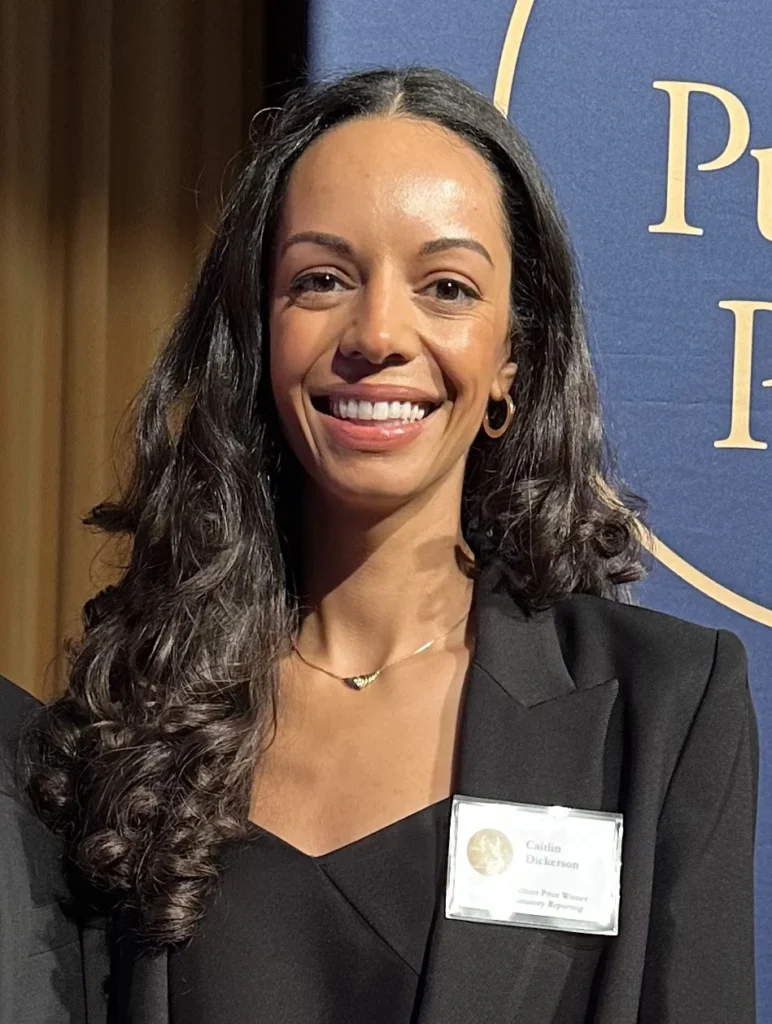
In May 2023, the Pulitzer Prize Board awarded Caitlin Dickerson the Pulitzer Prize for Public Interest Journalism, the field’s highest honor, for this investigation. The citation recognized the story’s “exhaustive and definitive account” of how the policy was conceived and carried out.
The Pulitzer Prize for Public Interest is reserved for journalism that serves “the public interest.” Past recipients include watershed investigations into government corruption, corporate malfeasance, and public health crises. Dickerson’s prize placed her in that tradition, the tradition of journalism as a democratic accountability mechanism.
Immigration Journalism: Dickerson’s Broader Body of Work
The family separation story is Dickerson’s most celebrated single piece, but it sits within a broader body of work on immigration that spans over a decade. Her reporting has covered:
- DACA and Dreamers, the legal and human dimensions of Deferred Action for Childhood Arrivals
- Asylum policy, how the system processes claim, where it fails, and who bears the cost of failure
- Deportation, the mechanics and human consequences of removal proceedings
- Border conditions, reporting from border communities, detention facilities, and ports of entry
- Immigration enforcement, how ICE and CBP operate, and with what degree of oversight
- The immigration court backlog, one of the most chronic and underreported crises in American government
Across all of it, Dickerson’s approach has remained consistent: facts first, sources verified, human impact centered. She operates in the space between advocacy journalism and detached neutrality, firmly committed to accuracy, alert to the humanity of everyone she covers.
Caitlin Dickerson as a Public Speaker
Dickerson’s expertise, her Pulitzer Prize, and her decade-plus of experience on one of America’s most contested policy beats have made her a sought-after speaker for institutions that engage seriously with journalism, policy, and democratic accountability.
Speaking Topics
Her speaking engagements typically address themes including:
- Immigration and American identity, how immigration policy reflects and shapes the country’s self-understanding
- Investigative journalism methodology, what an 18-month investigation actually looks like: sourcing, document analysis, verification, and narrative construction
- The human cost of border policy, moving beyond statistics to the individual lives affected by policy decisions
- How journalism holds power accountable, the role of the free press in a democratic society
- Reporting in polarized environments, how to pursue accuracy and fairness when a topic has become politically weaponized
Who Books Caitlin Dickerson
Dickerson is typically booked by:
- Journalism schools and university communications programs seeking a practitioner perspective on investigative reporting
- Law schools and policy institutes examining immigration law and enforcement
- Immigration advocacy organizations that use rigorous journalism as an educational tool
- University speaker series in political science, public policy, and international relations departments
- Media organizations and editorial conferences focusing on accountability journalism
Her combination of academic credibility (Georgetown-educated), institutional prestige (The Atlantic, The New York Times, NPR), and demonstrable investigative achievement (Pulitzer Prize) makes her one of the most compelling journalism speakers available for serious academic and policy audiences.
Caitlin Dickerson Net Worth 2026
Caitlin Dickerson’s estimated net worth in 2026 is approximately $1.5 to $2 million. This figure reflects her long career at major media institutions, her current role as a staff writer at The Atlantic, and the range of professional activities that flow from her stature in American journalism.
Her income sources include:
- Staff writer salary at The Atlantic, senior staff writers at major national publications typically earn in the range of $100,000–$200,000 annually
- The 2023 Pulitzer Prize, the Pulitzer Prize carries a cash award of $15,000 per category
- Speaking fees, Pulitzer Prize-winning journalists at the height of their careers command speaking fees typically in the range of $10,000–$25,000 per engagement
- Fellowship and grant income, investigative journalism of Dickerson’s scope is often supported by journalism foundation grants and fellowships
- Book rights and licensing potential, a body of work of this significance creates publishing opportunities
Net worth estimates for working journalists, even highly celebrated ones, are inherently approximate. Dickerson has not publicly disclosed her finances, and the figures above represent informed estimates based on industry standards and career trajectory.
Personal Life
Caitlin Dickerson is known within journalism circles for two qualities that rarely coexist in equal measure: extraordinary attention to detail and genuine warmth with sources. The family separation investigation, which required gaining the trust of officials who had participated in a deeply controversial policy, is impossible without both.
She is based on the East Coast of the United States, consistent with her work at Washington D.C.-proximate institutions. Beyond that, she maintains a deliberate separation between her professional profile and her personal life, a choice that is both understandable and appropriate for a journalist whose work has placed her at the center of intense political debates.
What her reporting reveals about her character is perhaps more instructive than biographical detail: she is patient, methodical, and motivated by a conviction that journalism matters, that the act of finding out what actually happened and telling people about it is one of the most important things a person can do in a democracy.
Caitlin Dickerson Best Quotes
The following quotes represent Dickerson’s public statements on journalism, immigration, and accountability, drawn from interviews, award acceptance contexts, and her published work.
1. On the purpose of investigative journalism: “The goal is always to find out what actually happened, not what officials say happened, not what advocates say happened, but what the documents and the people who were there can actually tell you.”
2. On the family separation investigation: “I wanted to understand how a policy like this gets made. Not to assign blame simplistically, but to follow the decisions back to the people who made them and understand what they knew and when they knew it.”
3. On immigration as a journalistic beat: “Immigration is a story about America more than it is a story about immigrants. It tells you what the country actually values versus what it says it values.”
4. On the challenge of covering polarized topics: “The job isn’t to make both sides happy. The job is to be accurate. Sometimes accuracy makes everyone angry, and that’s usually a sign you’re doing it right.”
5. On source relationships: “People talk to you because they trust you. You build that trust by being honest about what you’re doing, by getting things right, and by caring about the story for the right reasons.”
6. On the children affected by family separation: “These are children. Whatever your view of immigration policy, the starting point has to be that these are children, and they were separated from their parents by the government of the United States.”
7. On the role of The Atlantic in giving her time to report: “Long-form journalism takes time. The story I wrote could not have been written on a daily deadline. You need time to find the documents, to build relationships with sources, to verify everything carefully.”
8. On winning the Pulitzer Prize: “The award belongs to everyone who agreed to speak with me, the officials, the lawyers, the advocates, and most importantly, the families.”
Frequently Asked Questions
Caitlin Dickerson is an American investigative journalist and staff writer at The Atlantic, specializing in immigration policy and border affairs. She previously worked at NPR and The New York Times. In 2023, she was awarded the Pulitzer Prize for Public Interest Journalism for her investigation into the Trump administration’s family separation policy, widely considered one of the defining works of American investigative journalism in the 2020s.
Caitlin Dickerson won the 2023 Pulitzer Prize for Public Interest Journalism for her article “Inside the Chaos of the Trump Administration’s Child-Separation Policy,” published in The Atlantic in 2022. The investigation, the product of 18 months of reporting, documented how the “zero tolerance” policy was designed, implemented, and how it resulted in the separation of more than 5,500 children from their parents at the U.S.-Mexico border.
Caitlin Dickerson’s estimated net worth in 2026 is approximately $1.5 to $2 million. Her wealth reflects a career spanning NPR, The New York Times, and The Atlantic, combined with Pulitzer Prize recognition, professional speaking fees (estimated $10,000–$25,000 per engagement for top-tier journalists), and potential fellowship and publishing income. As a working journalist, she has not publicly disclosed her finances; all figures are informed estimates.
Caitlin Dickerson writes primarily about immigration policy and its human consequences. Her work covers asylum law, deportation, DACA, border enforcement, immigration court backlogs, and the lived experience of immigrants navigating the American legal system. She approaches the beat with deep legal and policy knowledge, a strong commitment to document-based reporting, and a consistent focus on the individual human stories behind complex policy debates.
Caitlin Dickerson speaks on immigration policy and American identity, investigative journalism methodology, the human cost of border enforcement, and the role of journalism as a democratic accountability mechanism. She is booked by journalism schools, law schools, university speaker series, and policy institutes. Her speaking engagements typically draw on her Pulitzer Prize-winning investigation and her decade of experience on one of America’s most contested policy beats.
Conclusion
The Caitlin Dickerson biography is, at its core, a story about the value of doing the work. Not the fast work, but the slow, careful, methodical kind, the kind that takes 18 months, hundreds of interviews, and thousands of documents before a single word is published. The result, in Dickerson’s case, was a piece of journalism that won America’s highest press award and permanently altered the public record on one of the most contested policy episodes in recent American history.
From her early days at NPR to her years at The New York Times to her current role at The Atlantic, Dickerson has demonstrated that immigration journalism at its best is both rigorously factual and profoundly human. She is one of the most important journalists working in America today.
Leave a Reply