
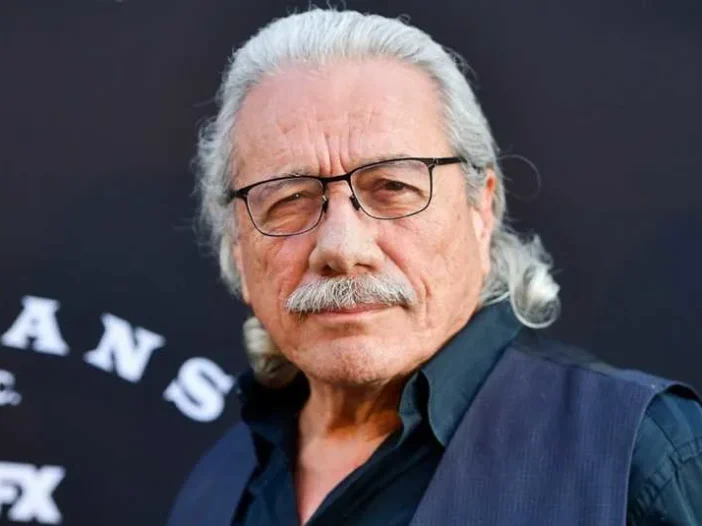
He turned down Scarface, Red Dawn, and Firestarter because they didn’t mean enough to him, and then built one of the most decorated careers in Hollywood history anyway. Edward James Olmos is the Mexican-American actor, director, activist, and cultural force who transformed how Latinos are portrayed in American film and television.
From his Tony-nominated Broadway debut to an Emmy Award for Miami Vice, an Academy Award nomination for Stand and Deliver, and iconic roles in Blade Runner, Battlestar Galactica, and Mayans M.C., his career spans more than 50 years of uncompromising excellence.
This complete Edward James Olmos biography covers his East Los Angeles childhood, his rise from baseball prodigy to rock musician to Tony-nominated actor, his movies and TV shows, his wives, his net worth, and whether this Hollywood giant is still alive in 2026.
Quick Facts About Edward James Olmos
| Detail | Information |
| Full Name | Edward Huizar Olmos |
| Date of Birth | February 24, 1947 |
| Age (2026) | 79 years old |
| Birthplace | East Los Angeles, California, USA |
| Nationality | American (Mexican-American heritage) |
| Height | 5 feet 9 inches (175 cm) |
| Net Worth (2026) | ~$8–12 million (estimated) |
| Marriages | Kaija Keel (1971–1992); Lorraine Bracco (1994–2002); Lymari Nadal (2002–2013) |
| Children | Mico Olmos, Bodie Olmos (biological); Daniela, Michael, Brandon, Tamiko (adopted) |
| Occupation | Actor, Director, Producer, Activist |
| Is Still Alive? | Yes, as of 2026 |
Early Life and Background
Edward Huizar Olmos was born on February 24, 1947, at the First Japanese Hospital in East Los Angeles, California, to Pedro Olmos Escamilla, a Mexican immigrant welder and mail carrier, and [Mary] Eleanor (née Huizar), a Mexican-American woman of Tejano ancestry whose life story was itself extraordinary. Eleanor would go on to work as a taxi driver, sheriff, electrical engineer, and nurse, eventually becoming the first woman to walk into the LA General AIDS ward.
When Edward was seven years old, his parents divorced. He was raised primarily by his American Baptist maternal great-grandparents while his parents worked to support the family. His great-grandfather was a church custodian. His father remained in his life through visits, it was his father who first took him to the Egyptian, Chinese Theatre, El Capitan, and Paramount after Sunday church services, introducing him to cinema and dance.
Olmos grew up in what he describes as a community “salad” of many separate ethnicities, diverse, complex, and not without danger. To keep himself away from street gangs and drugs, he immersed himself in baseball, becoming a Golden State batting champion and earning a spot in the Los Angeles Dodgers’ farm system as a catcher at age 13.
He graduated from Montebello High School in 1964. During high school, he lost the Student Body President race to future California Democratic Party Chair Art Torres. He later earned an Associate Arts Degree in Sociology and Criminal Justice from East Los Angeles College in 1966.
Career Beginnings
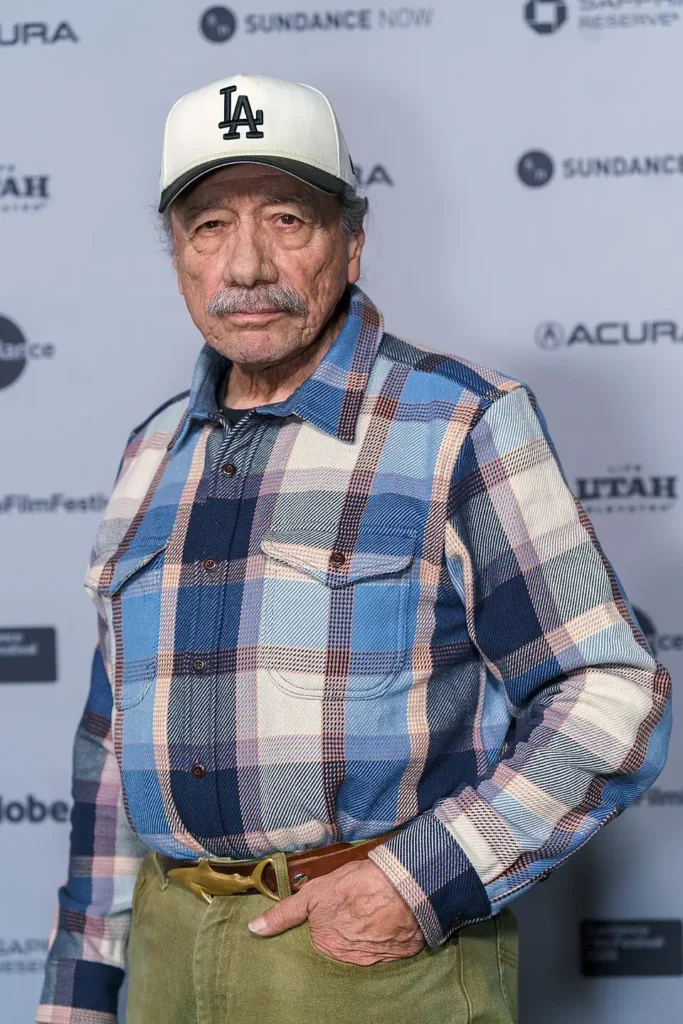
At age 15, Edward James Olmos left baseball for music, a decision that infuriated his father. He became the lead singer of a psychedelic/hard rock band he named Pacific Ocean, so called because it was to be “the biggest thing on the West Coast.” The band performed at clubs along Sunset Strip and released the album Purgatory via VMC Records in 1968, followed by a nationwide tour in 1969.
The band years were chaotic: Olmos once slipped on stage and landed on a nail that went through his knee; another time he jumped from the top of an organ into the drum set, knocking himself unconscious. He met his first wife, Kaija Keel, daughter of musical film star Howard Keel, at a Pacific Ocean gig, and the two married in 1971.
Recognizing he was a self-admittedly “terrible singer,” Olmos began taking acting classes to improve his stage presence. He discovered, to his surprise, that he had a natural gift for projecting the spoken word. He left music behind, and never looked back.
To support his young family, he delivered antique furniture by day while attending auditions at night. The bit parts came slowly and without dignity: small roles on Kojak, Hawaii Five-O, CHiPs, and Police Woman, almost always playing the tough guy or the criminal. He later joked that he was “the only person Jack Lord ever shot in the back, ever. That’s how bad I was.”
Major Career Highlights
Zoot Suit, The Breakthrough (1978–1981)
In 1978, everything changed. Olmos was cast as El Pachuco, the stylized, mythic narrator, in Luis Valdez’s landmark musical drama Zoot Suit, which dramatized the 1942 Sleepy Lagoon murder case and the persecution of young Mexican Americans in wartime Los Angeles.
The play was expected to run ten days. It ran for a year in Los Angeles, then moved to Broadway, where Olmos earned a Tony Award nomination. He also won the Los Angeles Drama Critics Circle Award and a Theatre World Award. The 1981 film version extended the role’s impact to a national audience.
The role established Olmos as a defining voice for Latino stories on stage and screen, and set the principles that would govern his entire career: he would never accept a role that demeaned Latino people, even if it meant walking away from money.
Blade Runner (1982), A Sci-Fi Landmark
Olmos appeared as Detective Gaff in Ridley Scott’s Blade Runner (1982), a role he developed by constructing his own invented language called “Cityspeak”, a street argot blending Hungarian, Japanese, French, Chinese, and Spanish. His atmospheric, enigmatic presence became one of the film’s most memorable elements.
He reprised the role in the short film Blade Runner: Black Out 2022 and in Blade Runner 2049 (2017), spanning 35 years of the same character, a record virtually unmatched in science fiction cinema.
Miami Vice, The Household Name (1984–1989)
In 1984, Olmos joined the cast of NBC’s Miami Vice partway through its first season, playing the brooding, ice-cold police Lieutenant Martin Castillo. He appeared in 106 episodes through the show’s five-season run from 1984 to 1989 opposite Don Johnson and Philip Michael Thomas.
His performance earned him:
- 1985 Primetime Emmy Award, Outstanding Supporting Actor in a Drama Series
- 1986 Golden Globe Award, Best Supporting Actor in a Series, Miniseries, or Television Film
Olmos retained creative control over the Castillo character, notably refusing to play him as the stereotyped Latino villain the producers initially envisioned. Castillo became one of the most compelling straight-man characters on 1980s television: silent, deadly, and utterly authoritative.
He privately voiced concerns about the show’s stereotyping of women and its formulaic plots, but his professional commitment to the role never wavered for five years.
Stand and Deliver, The Oscar Nomination (1988)
The defining performance of Olmos’s film career came when he was cast as Jaime Escalante, a real-life Bolivian immigrant and math teacher at Garfield High School in East Los Angeles who inspired his students to pass the AP Calculus exam, in Stand and Deliver (1988).
Olmos gained 35 pounds for the role, wore a prosthetic bald cap, and studied Escalante obsessively. The result was a performance of astonishing authenticity.
The film earned him:
- Academy Award nomination for Best Actor, making him the first American-born Hispanic to receive this nomination
- Golden Globe Award for Best Actor in a Drama
- Independent Spirit Award for Best Male Lead
The film was selected for preservation in the National Film Registry of the Library of Congress in 2011, reserved for works that are “culturally, historically, or aesthetically significant.”
Stand and Deliver remains one of the most widely taught films in American schools, used in education classrooms to this day to inspire discussions about potential, perseverance, and the transformative power of a great teacher.
American Me, Directorial Debut (1992)
In 1992, Olmos made his feature film directorial debut with American Me, a brutal, unflinching portrait of Chicano gang life in Los Angeles, from the juvenile hall to the prison system. He also starred in the film and co-produced it.
The film was controversial, both artistically and personally. Several gang members reportedly threatened Olmos after its release for its graphic portrayal of prison violence. The film generated serious critical attention and cemented his status as a filmmaker willing to tackle uncomfortable truths about the community he came from.
Selena (1997), A Generation’s Story
Olmos played Abraham Quintanilla, the demanding, loving father of murdered Tejano superstar Selena Quintanilla-Pérez, opposite Jennifer Lopez in Selena (1997). The film introduced Selena’s story to a mainstream audience and became a cultural touchstone for Mexican-Americans. His performance as the protective, complex patriarch anchored one of the most emotionally resonant Latino films of the decade.
Battlestar Galactica, A Second Career Peak (2004–2009)
Beginning in 2003 with the miniseries and running through 2009, Olmos played Admiral William Adama on the reimagined Battlestar Galactica on the Sci-Fi Channel. The show became one of the most critically acclaimed science fiction series in television history, praised for its sophisticated political allegory and character depth.
Olmos directed four episodes of the series and described it as one of the most meaningful projects he had ever been involved with. The show ran 73 episodes and earned him an entirely new generation of devoted fans who knew nothing of Miami Vice or Blade Runner.
Mayans M.C., Still Working at 70+ (2018–Present)
Since 2018, Olmos has played Felipe Reyes, the father of two biker gang members, on FX’s Mayans M.C., the Sons of Anarchy spinoff. The recurring role demonstrated that at over 70 years old, Olmos remained a compelling, in-demand television presence. His adopted son, Michael D. Olmos, directed episodes of Season 4 of the same series, a genuine family production.
Other Notable Movies and TV Shows
His filmography across five decades includes:
- The Ballad of Gregorio Cortez (1982), produced and distributed independently when no studio would touch it
- My Family/Mi Familia (1995), narrator
- 12 Angry Men (1997, TV film)
- The West Wing (1999–2000), recurring as Justice Roberto Mendoza
- Dexter (2011), Season 6 recurring role
- Coco (2017, Pixar), voice of Chicharrón
- Blade Runner 2049 (2017), reprising Detective Gaff after 35 years
- Narcos (2017, Netflix)
- A Dog’s Way Home (2019)
- The Devil Has a Name (2019), director
Edward James Olmos as a Public Speaker
Beyond his acting career, Edward James Olmos has been a prolific public speaker for decades, delivering talks up to 150 times a year at schools, universities, corporations, and civic organizations. His speaking work is inseparable from his activism.
His core speaking themes include:
- The Latino experience in America, representation, identity, and the fight for authentic storytelling
- Gang prevention and the path from the barrios of East LA to national prominence
- Education as liberation, drawing directly from his experience making Stand and Deliver
- Racial unity and civic responsibility, including his famous broom-and-shovel response to the 1992 LA riots
- Cultural pride and the power of Latino art, literature, and history
- Voter registration and civic engagement, particularly in underrepresented communities
Who books Edward James Olmos:
- Universities, community colleges, and high schools, particularly those with large Latino student populations
- Diversity, equity, and inclusion events for major corporations
- Documentary and arts-focused conferences
- Nonprofit organizations serving youth, gang prevention, and education
- Latino cultural festivals and civic events
His Americanos multimedia project (1999), a five-year Smithsonian traveling photography exhibition, music CD, and documentary celebrating Latino life, exemplifies how he integrates activism and art into a single platform. He co-founded Latino Literacy Now in 1997 and Latino Public Broadcasting in 1998, expanding his advocacy beyond individual speaking appearances into lasting institutional infrastructure.
Edward James Olmos Net Worth 2026
Edward James Olmos’s estimated net worth in 2026 is approximately $8–12 million, based on multiple sources including Celebrity Net Worth. The range reflects the genuine difficulty of assessing wealth across a 50-year career in acting, directing, producing, and activism.
His primary income streams include:
- Television acting, 106 episodes of Miami Vice, 73 episodes of Battlestar Galactica, multiple seasons of Mayans M.C., and dozens of guest appearances across 50+ years
- Film roles, Blade Runner (1982 and 2017), Stand and Deliver, Selena, Coco, and more than 120 total credits
- Directing fees, American Me, Walkout (HBO), The Devil Has a Name, and Battlestar Galactica episodes
- Producing work, through Olmos Productions, which produced documentaries including Lives in Hazard and It Ain’t Love
- Speaking fees, commanding premium rates at up to 150 engagements per year
- Olmos Productions and Latino Public Broadcasting, institutional enterprises he founded
- Latino Book & Family Festival, co-produced since 1997, generating both cultural and commercial impact
His career philosophy, turning down lucrative roles that lacked meaningful content, cost him some significant paydays. He declined Scarface, Red Dawn, and Firestarter, and passed on a permanent Hill Street Blues contract. But the authentic body of work he built has proven far more durable than any single franchise would have been.
Personal Life, Wives, Children, and Life Today
Edward James Olmos has been married three times and has both biological and adopted children, making his family story as complex as any of his film roles.
Marriage 1: Kaija Keel (1971–1992) His first wife was Kaija Keel, daughter of musical film star Howard Keel. They met at a Pacific Ocean concert, married in 1971, and had two sons together:
- Mico Olmos
- Bodie Olmos, who became an actor in his own right, appearing in Battlestar Galactica alongside his father
The marriage ended after 21 years in 1992. They also adopted four children: Daniela, Michael, Brandon, and Tamiko. His adopted son Michael D. Olmos later became a director, working on Mayans M.C. Season 4.
Marriage 2: Lorraine Bracco (1994–2002) In 1994, Olmos married actress Lorraine Bracco (The Sopranos). The marriage ended in 2002 when Bracco filed for divorce.
Marriage 3: Lymari Nadal (2002–2013) He married actress Lymari Nadal in 2002. The couple divorced in 2013.
As of 2026, Olmos has not publicly remarried. He is described across sources as currently single and focused on his professional and activist work.
Is Edward James Olmos still alive? Yes, as of 2026, he is 79 years old and continues to be publicly active. He has been described across recent sources as fit and healthy, remaining involved in acting, directing, and advocacy work.
His famous acne scars, the result of severe cystic acne that marked his face, have been part of his appearance throughout his career and have never prevented him from commanding the screen as one of Hollywood’s most authoritative presences.
He is a devoted advocate for juvenile diabetes awareness (his younger brother has the disease), AIDS awareness, youth gang prevention, and children’s hospital support. He volunteered to help clean up the streets of Los Angeles after the 1992 Rodney King riots, sparking a grassroots effort that drew thousands of people into the streets, brooms in hand, to rebuild rather than destroy.
Edward James Olmos Best Quotes
On representation and refusing bad roles:
He vowed early in his career to never accept a role that demeaned Latinos or the Latino community, even if it meant walking away from paying work. That commitment led him to turn down Scarface, Red Dawn, and Firestarter, and to pass on a permanent Hill Street Blues contract.
On Stand and Deliver and the joy of learning:
“The film is really about the triumph of the human spirit. It’s about something we’ve lost, the joy of learning.”, On the mission behind his most celebrated performance, delivered in various interviews during the film’s 1988 release.
On his community in East LA: Olmos has described growing up in East Los Angeles as living in a “salad” of many separate ethnicities, a formulation he prefers to the “melting pot” metaphor, because a salad preserves each ingredient’s distinct character.
On the 1992 Los Angeles riots: After the Rodney King verdict sparked fires across Los Angeles, Olmos grabbed a broom and walked into the destruction to begin cleaning. Within two days, thousands of people had joined him. His response, embodying civic action over rage, earned him the John Anson Ford Award and recognition from the NAACP for leadership toward racial unity.
On declining to play the captain of the Enterprise: Olmos was contacted about playing the captain of the USS Enterprise on Star Trek: The Next Generation when it was in pre-production in 1986. He declined. The role went to Patrick Stewart, a decision that freed Olmos to continue pursuing projects that spoke directly to the Latino experience.
On fatherhood and adoption: Olmos has spoken throughout his career about adopting four children and raising a blended family while pursuing one of the most demanding careers in Hollywood, describing family as the anchor that grounded everything else.
On what Battlestar Galactica meant to him: He described Battlestar Galactica as one of the most meaningful projects he had ever been involved with, a show that used science fiction as a lens to examine the most urgent political and ethical questions of the early 21st century.
On the purpose of Latino storytelling:
“We are trying to get stories told, real stories, truthful stories, stories that reflect who we are as a people, as a culture, as a civilization.”, From various interviews and speaking engagements about his lifelong mission to expand and diversify Latino representation in American media.
Frequently Asked Questions
Yes, Edward James Olmos is alive as of 2026. Born on February 24, 1947, he is 79 years old. He remains professionally active, continuing his work in film, television, and public advocacy. His most recent major credits include Mayans M.C. on FX and Blade Runner 2049 (2017). He continues to speak publicly at schools, universities, and civic events, advocating for Latino representation and youth programs.
Edward James Olmos’s estimated net worth in 2026 is approximately $8–12 million, according to Celebrity Net Worth and multiple industry sources. His wealth was built over a 50-year career spanning major television roles in Miami Vice and Battlestar Galactica, film work including Blade Runner, Stand and Deliver, and Selena, directing fees, producing credits, and decades of premium speaking engagements at up to 150 events per year.
Edward James Olmos has been married three times: to Kaija Keel (daughter of actor Howard Keel) from 1971 to 1992, to actress Lorraine Bracco from 1994 to 2002, and to actress Lymari Nadal from 2002 to 2013. As of 2026, he has not publicly remarried and is believed to be single. He has two biological sons, Mico and Bodie Olmos, and four adopted children.
In Mayans M.C. on FX, the Sons of Anarchy spinoff, Edward James Olmos plays Felipe Reyes, the father of main characters Ezekiel and Angel Reyes. He has appeared in the role since the series premiere in 2018. His adopted son, Michael D. Olmos, directed episodes of Season 4 of the same series, making it a genuine family project for the Olmos family.
In Ridley Scott’s 1982 neo-noir masterpiece Blade Runner, Edward James Olmos played Detective Gaff, a mysterious, origami-folding police officer who speaks a constructed street language called “Cityspeak” that Olmos created himself, blending Hungarian, Japanese, French, Chinese, and Spanish. He reprised the role in the short film Blade Runner: Black Out 2022 and in Blade Runner 2049 (2017), making his connection to the franchise span 35 years.
Conclusion
The Edward James Olmos biography is the story of a man who built his entire career on a single uncompromising principle: only tell stories that matter.
From a barrio in East Los Angeles where he played baseball to stay out of gangs, to a Broadway stage, to the streets of 1992 Los Angeles with a broom in his hands, to the bridge of the Galactica, to Felipe Reyes’s butcher shop on Mayans M.C., Olmos has never stopped working, never stopped advocating, and never stopped expanding what it means to be Latino in American popular culture. At 79 years old, he remains fully alive, fully present, and fully himself.
Leave a Reply