
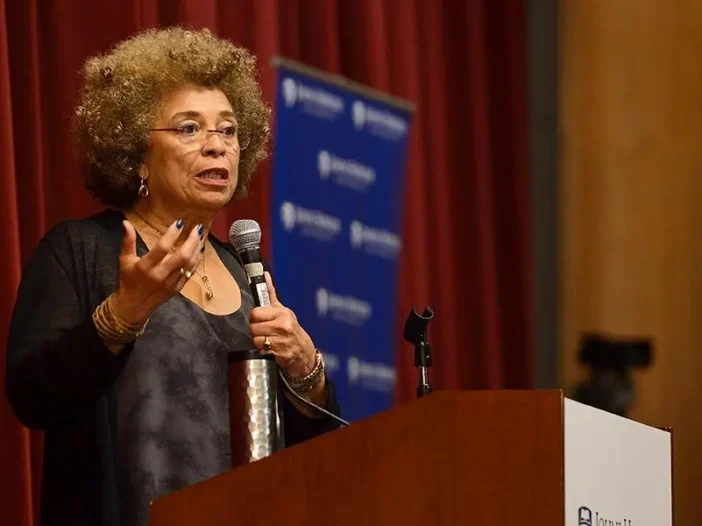
Angela Davis’s face, frozen in that 1970 FBI Most Wanted poster, her Afro unmistakable, became one of the most arresting images of 20th-century American radicalism. Decades later, she stands as a Distinguished Professor Emerita at the University of California, Santa Cruz, a bestselling author, and one of the most sought-after speakers in America on prison abolition, racial justice, and Black feminism.
Born January 26, 1944, in Birmingham, Alabama, Davis rose from the crucible of legal segregation and racial violence to become a global intellectual force. Arrested, jailed for 16 months, acquitted, and ultimately vindicated, her life story is one of the most dramatic and consequential in modern American history.
This complete Angela Davis biography covers her early life, education, activism, academic career, books, speaking topics, net worth, and enduring legacy.
Quick Facts About Angela Davis
| Detail | Information |
| Date of Birth | January 26, 1944 |
| Birthplace | Birmingham, Alabama, USA |
| Nationality | American |
| Education | Brandeis University (BA); Goethe University, Frankfurt; University of California, San Diego (MA, PhD candidate) |
| Occupation | Professor Emerita, Author, Activist, Public Speaker |
| Net Worth (est.) | $5 million |
| Spouse / Partner | Long-term partner (privately maintained) |
| Children | None publicly confirmed |
| Notable Works | Are Prisons Obsolete? Women, Race, & Class, Freedom Is a Constant Struggle |
Early Life and Background
Angela Yvonne Davis was born on January 26, 1944, in Birmingham, Alabama, a city then defined by legal racial apartheid and frequent racial terror. She grew up in a neighbourhood on the north side of the city that locals grimly nicknamed “Dynamite Hill” because of the frequency with which white supremacists bombed the homes of Black families who dared to move there.
Her parents, B. Frank Davis and Sallye Bell Davis, were educators and community activists. Her mother, in particular, was deeply involved in the Southern Negro Youth Congress, a progressive civil rights organization, giving young Angela an early front-row seat to organized resistance. The Davis household was one where books, politics, and the struggle for equality were daily conversation.
The defining trauma of her youth came on September 15, 1963, when a Ku Klux Klan bomb tore through the 16th Street Baptist Church in Birmingham, killing four young Black girls: Addie Mae Collins, Cynthia Wesley, Carole Robertson, and Carol Denise McNair. Davis knew these children personally. That act of terror seared itself into her conscience and, by her own account, crystallized her understanding that racism in America was not merely individual prejudice, it was systemic and lethal.
Career Beginnings, Education and Intellectual Formation
Davis was intellectually precocious, and at 15 years old she was selected for a progressive interracial education program called “American Friends Service Committee”, which placed her at Elisabeth Irwin High School in New York City, a school with a strong left-wing tradition whose alumni included folk singer Woody Guthrie’s children.
She enrolled at Brandeis University in Waltham, Massachusetts, in 1961, where she encountered the philosophy of Herbert Marcuse, a Frankfurt School scholar whose critiques of capitalism and authoritarianism would fundamentally shape her worldview. Marcuse became her mentor, a relationship that would define her intellectual trajectory.
Davis studied abroad at the Goethe University in Frankfurt, Germany, immersing herself in the thought of Theodor Adorno and the broader tradition of critical theory. She returned to the United States to pursue graduate studies at the University of California, San Diego under Marcuse, who had relocated there. It was during this period that her theoretical convictions merged fully with political action.
Major Career Highlights
The Communist Party USA and Black Panther Association
By the late 1960s, Davis had joined the Communist Party USA and became publicly affiliated with the Black Panther Party, two affiliations that placed her squarely in the crosshairs of FBI Director J. Edgar Hoover’s COINTELPRO program, which aggressively targeted left-wing and Black liberation organizations.
Her association with the Panthers was ideological and organizational, not paramilitary. She was a thinker and organizer, not a militant in the armed sense, a distinction that would prove legally critical.
The FBI Most Wanted List, 1970
The most dramatic episode of Davis’s life unfolded on August 7, 1970. A young man named Jonathan Jackson used guns that were legally registered to Angela Davis to take over a Marin County, California courtroom, attempting to free his brother, incarcerated activist George Jackson. The courthouse takeover ended in a shootout. Judge Harold Haley, Jonathan Jackson, and two inmates were killed.
California law at the time held that anyone who supplied weapons used in a murder could be charged with murder. Davis fled. On August 18, 1970, President Richard Nixon personally congratulated the FBI on placing her on the Ten Most Wanted Fugitives list. She was captured in New York City on October 13, 1970.
Trial, Acquittal, and International Campaign
Davis spent 16 months in jail while awaiting trial, denied bail for a significant portion of that time. Her imprisonment sparked a global movement. “Free Angela Davis” became a rallying cry from the United States to the Soviet Union to Western Europe. The Rolling Stones referenced her in “Sweet Black Angel.” Activist networks raised money and awareness across dozens of countries.
On June 4, 1972, an all-white jury acquitted Davis on all charges, murder, kidnapping, and criminal conspiracy. The verdict was seen as a landmark moment for the American left and for civil liberties advocates broadly.
Academic Career at UC Santa Cruz
Following her acquittal, Davis rebuilt her life in the academy. She joined the faculty of the University of California, Santa Cruz, where she would spend the majority of her career in the History of Consciousness and Feminist Studies departments. She was appointed Distinguished Professor Emerita upon her retirement, among the highest honours the UC system confers.
Her scholarship focused on race, gender, incarceration, and political economy, and she trained generations of scholars who have gone on to shape fields from critical prison studies to Black feminist theory.
Books That Shaped Movements
Davis is the author of multiple influential books that have entered the canon of American radical thought:
- Women, Race, & Class (1981), A landmark intersectional analysis of how race, gender, and class shape the experience of American women, still widely taught in university courses today.
- Women, Culture & Politics (1989), A collection of essays examining culture as a site of political struggle.
- Blues Legacies and Black Feminism (1998), A scholarly examination of blues artists Gertrude “Ma” Rainey, Bessie Smith, and Billie Holiday as proto-feminist voices.
- Are Prisons Obsolete? (2003), Perhaps her most widely read work; a sharp, accessible argument that the modern prison-industrial complex is a form of racialized social control. It is a foundational text for the prison abolition movement.
- Freedom Is a Constant Struggle: Ferguson, Palestine, and the Foundations of a Movement (2016), Connects Black liberation struggles in the United States to Palestinian rights and global solidarity movements.
Angela Davis as a Public Speaker
Angela Davis is one of the most in-demand radical public intellectuals on the American and international speaking circuit. She is regularly booked by:
- Universities and colleges hosting social justice, racial equity, and Black history programming
- Civil rights organizations and advocacy groups
- Labour unions and progressive foundations
- International human rights conferences
Her speaking fee is estimated between $30,000 and $100,000 per engagement, depending on the event type, audience size, and whether travel and logistics are included, placing her firmly in the premium tier of activist speakers.
Angela Davis Speaking Topics
Her keynote addresses and moderated conversations typically cover:
- Prison abolition and criminal justice reform, her signature issue; she argues the prison system should be dismantled rather than reformed.
- Racial justice and the history of white supremacy in America
- Black feminism and intersectionality, the ways race, gender, and class overlap in lived experience.
- Anti-capitalism and economic justice
- Palestine solidarity and global human rights
- The legacy of the civil rights movement and its unfinished agenda
Davis is particularly popular on college and university campuses, where her appearances often coincide with Black History Month, Martin Luther King Jr. Day programming, or social justice lecture series. Her presence generates significant student engagement and institutional attention.
Angela Davis Net Worth 2026
Angela Davis’s estimated net worth is approximately $5 million, accumulated over a decades-long career as an academic, author, and speaker.
Her primary income streams include:
- University salary and pension, A long career as a tenured and then Distinguished Professor at UC Santa Cruz, a public research university in the University of California system, built a substantial base of financial security.
- Book royalties, Works like Are Prisons Obsolete? and Women, Race, & Class remain perpetually in print and are assigned in thousands of university courses annually, generating ongoing royalty income.
- Speaking fees, at an estimated $30,000–$100,000 per engagement, even a modest schedule of speaking appearances per year represents significant income.
- Documentary and media appearances, Davis has appeared in numerous documentary films, including Shola Lynch’s Free Angela and All Political Prisoners (2012), which brought renewed attention to her story and expanded her public platform.
At 82 years old in 2026, Davis remains active, though her public schedule has become more selective. Her legacy and platform sustain her financial position and public relevance simultaneously.
Personal Life
Angela Davis has been notably private about her personal relationships throughout her public life. She has spoken publicly about being in long-term partnerships, and in interviews has discussed her identity in ways that suggest a non-traditional personal life by mainstream standards, though she rarely elaborates.
She has no publicly confirmed children.
Davis has resided primarily in Northern California for most of her adult life, connected to the University of California system and the Bay Area’s progressive political culture.
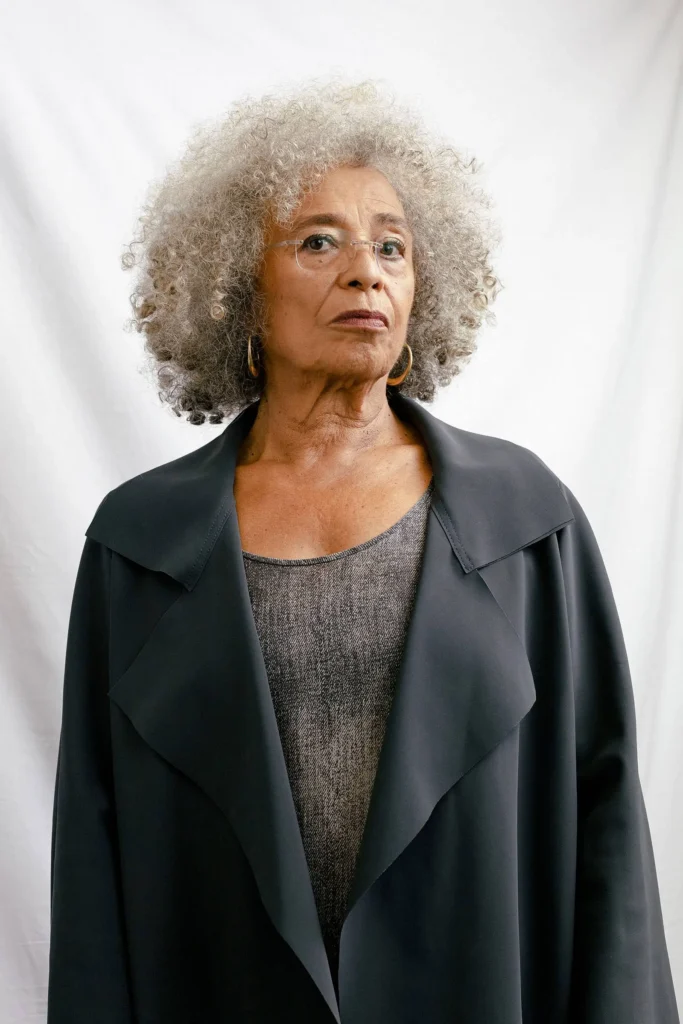
Her signature Afro hairstyle, one of the most iconic silhouettes in 20th-century American culture, became a symbol of Black pride, resistance, and unapologetic identity in the early 1970s. She has maintained it across five decades, and it remains instantly recognizable.
Raised in a household where religion and social justice were intertwined, Davis has engaged with liberation theology and the spiritual dimensions of the civil rights tradition, though she is most identified with secular Marxist and feminist frameworks.
Now in her early eighties, Angela Davis has described herself as still engaged with movement work, mentoring younger scholars, participating in coalitions, and contributing to the ongoing evolution of prison abolition as a practical policy agenda.
Angela Davis Best Quotes
On freedom and struggle:
“Freedom is a constant struggle.”, Title of her 2016 essay collection; Davis uses this phrase to argue that liberation is not a destination but an ongoing practice.
On the prison system:
“Prisons do not disappear social problems, they disappear human beings.”, From Are Prisons Obsolete? (2003); one of the most-cited lines in prison abolition literature.
On racism as a system:
“Racism is a much more clandestine, much more hidden kind of phenomenon, but at the same time it’s perhaps far more terrible than it’s ever been.”, Interview, 2013; Davis distinguishes between overt and structural racism.
On imagination and politics:
“I am no longer accepting the things I cannot change. I am changing the things I cannot accept.”, Widely attributed to Davis; used frequently in social movement contexts.
On her arrest and vindication:
“We have to talk about liberating minds as well as liberating society.”, From public lectures; Davis emphasizes that political freedom requires intellectual freedom.
On Black feminism:
“The process of empowerment cannot be simplistically defined in accordance with mainstream political criteria.”, From Women, Culture & Politics (1989).
On solidarity:
“You have to act as if it were possible to radically transform the world. And you have to do it all the time.”, From interviews and lectures; a defining statement of her political philosophy.
On young activists:
“I think we have to be more concerned with how our activism affects people rather than how it makes us feel about ourselves.”, From a 2014 interview; Davis pushes back against performative activism.
Frequently Asked Questions
Angela Davis is an American political activist, author, and academic born on January 26, 1944, in Birmingham, Alabama. She is a Distinguished Professor Emerita at the University of California, Santa Cruz, and a leading voice on prison abolition, racial justice, and Black feminism. She gained international attention in 1970 when she was placed on the FBI’s Ten Most Wanted list and later acquitted of all charges in 1972.
Angela Davis was arrested in October 1970 after guns legally registered in her name were used in a Marin County courthouse takeover that resulted in multiple deaths. Under California law, she was charged with murder, kidnapping, and conspiracy. After spending 16 months in jail and generating an international “Free Angela Davis” campaign, she was acquitted on all charges by an all-white jury in June 1972.
Angela Davis advocates for prison abolition, the belief that the prison-industrial complex should be dismantled rather than reformed. She is also a committed anti-capitalist, Black feminist, and intersectional thinker who argues that race, gender, and class cannot be separated in analysing social oppression. She supports Palestinian rights and broad global human rights solidarity, drawing connections between liberation struggles across different national contexts.
Angela Davis’s net worth is estimated at approximately $5 million as of 2026. Her wealth comes from multiple sources: a tenured academic career at the University of California, Santa Cruz; book royalties from perennial sellers like Are Prisons Obsolete? and Women, Race, & Class; and speaking fees estimated between $30,000 and $100,000 per engagement. She is among the higher-earning progressive public intellectuals in America.
Angela Davis speaks primarily on prison abolition and criminal justice reform, racial justice, Black feminism and intersectionality, anti-capitalism, and global human rights solidarity. She is frequently booked for university social justice programs, civil rights organizations, and international human rights conferences. Her talks combine historical analysis with contemporary policy argument, making her appealing to both academic and general audiences seeking depth and context.
Conclusion
The Angela Davis biography is, at its core, a story about the collision between one person’s extraordinary intellectual gifts and the most violent fault lines of American history. From the bombed streets of Birmingham to the global “Free Angela” campaign, from a radical UC professor’s lectern to the bestseller lists, Davis has lived multiple lives within one. Her work on prison abolition, Black feminism, and racial justice has shaped academic fields, legal debates, and activist movements across more than five decades.
At 82 years old, Angela Davis remains one of the most cited, quoted, and discussed public intellectuals in America. Whether you agree with her politics or not, her impact on American thought is undeniable.
Leave a Reply