
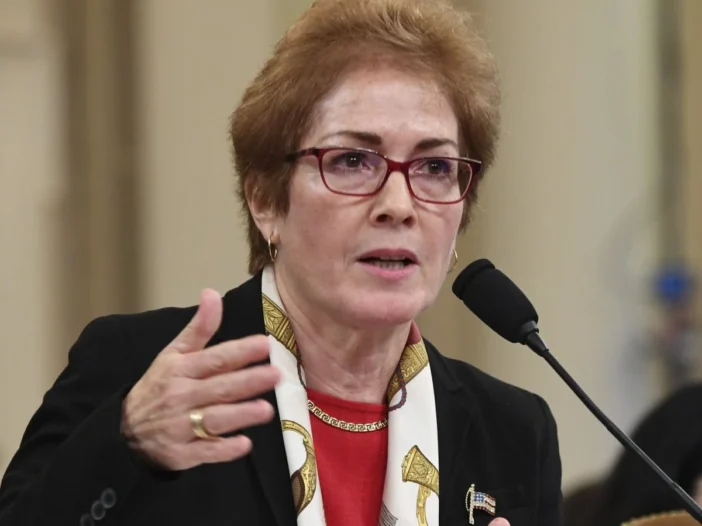
On October 11, 2019, Ambassador Marie Yovanovitch sat before Congress in a nationally televised impeachment inquiry, and was live-tweeted by President Donald Trump as she testified. In that extraordinary moment, she became one of the most recognized and discussed figures in modern American diplomatic history. Born in Montreal, Canada, to parents who had fled Soviet-controlled Europe, Yovanovitch spent 33 years as one of the U.S. State Department’s most decorated career diplomats, serving across three continents, surviving a war zone in Somalia, and rising to serve as U.S. Ambassador to Ukraine. Her sudden, politically charged removal in May 2019 set off a chain of events that would culminate in a historic impeachment hearing watched by millions. This is the complete Marie Yovanovitch biography, covering her early life, extraordinary career, impeachment testimony, bestselling memoir, speaking career, net worth, and legacy.
Quick Facts About Marie Yovanovitch
| Detail | Information |
| Date of Birth | 1958 |
| Birthplace | Montreal, Canada |
| Raised | Kent, Connecticut, USA |
| Nationality | American |
| Education | Princeton University; National War College |
| Occupation | Retired U.S. Ambassador, Author, Public Speaker, Senior Fellow |
| Notable Roles | U.S. Ambassador to Ukraine, Armenia, Kyrgyzstan |
| Net Worth (est.) | ~$3 million |
| Spouse/Partner | Not publicly disclosed |
| Children | None publicly disclosed |
| Major Book | Lessons from the Edge (2022) |
Early Life and Background
Marie Yovanovitch was born in 1958 in Montreal, Canada, but her family’s story begins much earlier, and much farther east. Her parents were European immigrants who had escaped Soviet-controlled Europe, navigating displacement and statelessness before ultimately building a new life in North America. That experience of flight, survival, and the search for freedom left a permanent imprint on their daughter.
The family eventually settled in Kent, Connecticut, a small town in the Litchfield Hills, where Yovanovitch grew up and attended school. Friends and colleagues describe her upbringing as modest but intellectually rich, shaped by parents who understood, first-hand, what it meant to live under authoritarian rule.
She went on to attend Princeton University, one of the nation’s most prestigious institutions, where she developed a deep interest in international relations and history. Her academic foundation, combined with the immigrant values instilled at home, made her an ideal candidate for a life in public service. She later attended the National War College in Washington, D.C., a capstone of senior-level U.S. national security education.
Her childhood, defined by stories of Soviet repression and the value of democratic freedom, would prove prophetic. Decades later, she would serve as the U.S. Ambassador to Ukraine, a country on the very front lines of the fight against Russian aggression.
Career Beginnings: Joining the Foreign Service
Marie Yovanovitch joined the U.S. Foreign Service in 1986, embarking on what would become one of the most distinguished careers in modern American diplomacy. The Foreign Service is notoriously difficult to enter, only a small fraction of applicants pass its rigorous written and oral examinations, and Yovanovitch was among them.
Her early postings took her to challenging environments that would test even the most seasoned diplomat. She served in Somalia during a period of profound instability, an assignment that required navigating genuine danger. She also served in Kyiv, Ukraine, London, and Moscow, a portfolio that gave her extraordinary depth in post-Soviet affairs.
Those early years were formative. Yovanovitch developed a reputation for meticulous preparation, political courage, and a steely commitment to the rule of law, qualities that would define her career and eventually put her at the center of one of Washington’s most consequential political controversies.
Major Career Highlights
U.S. Ambassador to Kyrgyzstan (2005–2008)
Yovanovitch’s first ambassadorship came in Kyrgyzstan, a landlocked Central Asian republic bordering China and Russia. During her tenure, she navigated complex geopolitical dynamics in a country undergoing democratic growing pains and competing pressure from Moscow and Washington.
Her work there established her as a skilled country-level manager, someone who could advance U.S. interests while maintaining productive relationships with host governments operating under difficult conditions.
U.S. Ambassador to Armenia (2008–2011)
Her second ambassadorship was to, another former Soviet republic with deep historical grievances and a complex relationship with both Russia and the West. In Yerevan, she promoted democratic governance, civil society development, and human rights, consistent themes throughout her career.
Colleagues from her Armenia posting remember her as deeply engaged with local civil society organizations and fiercely protective of her staff. She pushed back against corruption and political interference, a pattern that would later define, and ultimately cost her, her Ukraine posting.
U.S. Ambassador to Ukraine (2016–2019)
Yovanovitch’s most consequential and celebrated assignment began in 2016, when President Barack Obama nominated her as U.S. Ambassador to Ukraine. She was confirmed by the Senate and arrived in Kyiv at a pivotal moment, Ukraine was fighting a hot war with Russian-backed separatists in the east and was deeply committed to a process of democratic and anti-corruption reform.
During her tenure, Yovanovitch championed Ukrainian anti-corruption prosecutors and institutions, pushed for reform within Ukraine’s notoriously compromised justice system, and built strong relationships with civil society leaders. Ukrainian anti-corruption advocates who worked alongside her describe her as one of the most effective ambassadors the U.S. had sent to Kyiv in a generation.
Her removal from the post in May 2019, reportedly at the direction of the White House following a pressure campaign involving Rudy Giuliani and others, shocked the diplomatic community and set the stage for the impeachment inquiry that followed.
The Impeachment Testimony: A Defining Moment
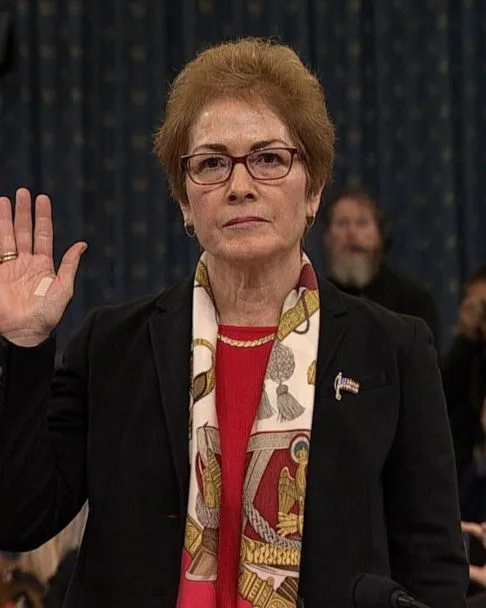
When the House Intelligence Committee launched its impeachment inquiry into President Trump in the fall of 2019, Marie Yovanovitch was among the first witnesses called. Her November 15, 2019, public testimony was unlike almost anything seen on Capitol Hill in recent memory.
As she spoke, calmly, methodically, with a diplomat’s precision, President Trump posted a series of tweets attacking her character, her record, and her career. Committee Chairman Adam Schiff paused the proceedings to read those tweets to her, in real time, asking for her reaction.
Her response was quiet, measured, and immediate: she said the tweets were “intimidating.”
The moment crystallized a national debate about the treatment of career government officials, the independence of the State Department, and the norms of congressional testimony. Yovanovitch’s composed dignity under extraordinary pressure drew widespread acclaim across the political spectrum, including from many Republican lawmakers who otherwise supported the president.
She had testified under a subpoena after the State Department initially directed her not to appear, making her one of several career officials who appeared over the objections of the executive branch.
The impeachment inquiry centered on a July 2019 phone call between President Trump and Ukrainian President Volodymyr Zelensky. Yovanovitch herself was not on that call, but her abrupt removal, and the circumstances surrounding it, formed a key component of the House’s fact-finding.
Lessons from the Edge, Her Memoir (2022)
In March 2022, Marie Yovanovitch published her memoir, Lessons from the Edge (Houghton Mifflin Harcourt). The title carries a double meaning, a reference both to the physical edge of U.S. diplomatic presence in the world’s most dangerous and contested places, and to the personal edge she found herself on when her career was upended by political forces.
The book chronicles 33 years of diplomatic service, from her early postings in Somalia and Moscow to her three ambassadorial appointments. It recounts the experience of being recalled from Ukraine, the preparation for her congressional testimony, and her reflections on what the episode revealed about the fragility of democratic institutions.
Lessons from the Edge became a Washington Post bestseller and was praised by reviewers for its restrained but deeply felt prose. Rather than a score-settling political polemic, the book reads as a meditation on public service, moral courage, and the cost of standing by one’s principles.
Key themes in the memoir include:
- The role of career diplomats in sustaining American foreign policy across administrations
- Anti-corruption work in post-Soviet states and the external pressures that undermine it
- The resilience required to serve in conflict zones and politically hostile environments
- Women in diplomacy and national security, Yovanovitch is candid about the additional obstacles female Foreign Service officers navigate
- The principles of the rule of law as both a diplomatic and personal value
Marie Yovanovitch as a Public Speaker
Since her retirement from the Foreign Service, Marie Yovanovitch has become one of the most sought-after public speakers on foreign policy, democratic governance, and diplomatic leadership. She commands attention in rooms that range from elite university lecture halls to major corporate governance forums.
Her speaking topics include:
- Democracy and the rule of law, how democratic institutions are built, strengthened, and threatened
- Ukraine and Russia, geopolitical context, the war, and what it means for the transatlantic alliance
- Diplomatic leadership under political pressure, lessons from 33 years in the Foreign Service
- Women in foreign policy and national security, barriers, progress, and what still needs to change
- Public service values and institutional integrity, why career government service matters in polarized times
- Anti-corruption and governance reform in emerging democracies
Yovanovitch is particularly in demand among:
- University international relations and political science programs, especially post-2022, as the war in Ukraine pushed her expertise to the top of every curriculum
- Foreign policy institutes and think tanks, including Council on Foreign Relations, Atlantic Council, and similar organizations
- Corporate governance and ESG forums, where her themes of institutional integrity resonate strongly with board-level audiences
- Civic organizations and libraries, particularly in the wake of her memoir’s publication
She holds a Distinguished Senior Fellowship at Georgetown University’s Institute for the Study of Diplomacy, which gives her a formal academic platform in addition to her speaking and writing activities.
Her speaking fee is estimated at $30,000–$75,000 per engagement, depending on the format, audience size, and whether the event is non-profit or corporate.
Marie Yovanovitch Net Worth 2026
Marie Yovanovitch’s estimated net worth is approximately $3 million, built through multiple streams of income accumulated over several decades of distinguished public and private service.
Income sources include:
- 33-year State Department career, Senior Foreign Service officers at the ambassador level earn salaries in the range of $130,000–$190,000 annually, plus housing allowances and diplomatic benefits abroad
- Book royalties, Lessons from the Edge (2022) was a Washington Post bestseller, generating meaningful advance and royalty income
- Speaking fees, estimated at $30,000–$75,000 per engagement, with demand surging significantly after the Russian invasion of Ukraine in February 2022
- Georgetown University fellowship, Senior Fellowship at the Institute for the Study of Diplomacy, which includes compensation alongside the academic platform
- Media appearances and consulting, periodic commentary on news networks and potential consulting arrangements with foreign policy organizations
Unlike many Washington figures, Yovanovitch is not known for the corporate board memberships or lobbying engagements that often follow high-profile government careers. Her post-government profile is more that of a scholar, author, and civic voice than a commercial operator.
Personal Life
Marie Yovanovitch has maintained a notably private personal life relative to her public prominence. She has never been married and has no children publicly disclosed, a personal situation she has addressed with characteristic directness, noting that the demanding nature of a Foreign Service career shaped many of her personal choices.
She is based primarily in the Washington, D.C., area, where she holds her fellowship at Georgetown and maintains proximity to the foreign policy institutions that form her professional community.
Colleagues describe her as deeply private, intensely professional, and quietly passionate about the causes she served throughout her career. She is known for:
- Mentoring younger Foreign Service officers, particularly women entering the diplomatic corps
- Advocacy for the State Department and career civil service, she has spoken publicly about what she views as the hollowing out of diplomatic capacity under political pressure
- A deep commitment to Ukrainian civil society, she has continued to speak and write about Ukraine since the February 2022 Russian invasion, often with visible emotion
- A love of the arts, she has mentioned in interviews that music and literature were sustaining forces through difficult postings
Her Georgetown fellowship keeps her engaged with the next generation of foreign policy professionals, a role she has described as among the most meaningful of her post-government activities.
Marie Yovanovitch Best Quotes
On the importance of diplomats:
“The State Department is not just a building. It’s a community of people committed to the idea that America’s strength comes from its engagement with the world.”, Georgetown University address, 2022
On her removal from Ukraine:
“I couldn’t understand it. I had served my country for 33 years. And yet, that’s not how it ended.”, Lessons from the Edge, 2022
On testifying before Congress:
“I have served this country for over 30 years. I will continue to do so.”, Impeachment testimony, November 2019
On the rule of law:
“The rule of law is not an abstraction. It is the ground we stand on. When it erodes, everything built on top of it becomes unstable.”, Council on Foreign Relations event, 2023
On women in diplomacy:
“Progress has been made. But the obstacles are real, and pretending otherwise helps no one, least of all the next generation.”, Georgetown University panel, 2023
On Ukraine after the 2022 invasion:
“Ukrainians are fighting for something universal, the right to choose their own future. That is worth understanding, and worth supporting.”, Atlantic Council address, March 2022
On public service:
“The people who choose public service over more lucrative private alternatives are not naive. They are, in many ways, the most clear-eyed people I know.”, Lessons from the Edge, 2022
On her parents’ story:
“My parents fled a regime that told them what to think, where to live, and who to be. That history is never far from my mind when I think about why this work matters.”, National Public Radio interview, 2022
Frequently Asked Questions
Marie Yovanovitch is a retired U.S. career diplomat who served in the Foreign Service for 33 years, including as U.S. Ambassador to Kyrgyzstan (2005–2008), Armenia (2008–2011), and Ukraine (2016–2019). Born in Montreal to parents who fled Soviet Europe, she became a nationally recognized figure during the first Trump impeachment inquiry in 2019. She is also the author of the memoir Lessons from the Edge (2022) and a Georgetown University Distinguished Senior Fellow.
Yovanovitch was recalled from her post in Kyiv in May 2019 following what she and others described as a pressure campaign orchestrated by Trump allies, including Rudy Giuliani, who viewed her as an obstacle to their efforts in Ukraine. She had developed a reputation as a fierce anti-corruption advocate, which put her at odds with certain Ukrainian political actors connected to those efforts. Her removal became a central element of the House impeachment inquiry.
Yovanovitch testified before the House Intelligence Committee on November 15, 2019, describing her 33-year career, her work in Ukraine, and the circumstances of her removal. During her public testimony, President Trump posted critical tweets about her in real time. When Committee Chairman Adam Schiff read those tweets to her, she responded that they felt “intimidating.” Her composed, dignified demeanour under that pressure became widely praised across party lines.
As of 2026, Yovanovitch remains active as a public speaker, author, and academic. She holds a Distinguished Senior Fellowship at Georgetown University’s Institute for the Study of Diplomacy, where she mentors future foreign policy professionals. She continues to speak nationally and internationally on Ukraine, democracy, and diplomatic leadership. Her 2022 memoir, Lessons from the Edge, continues to be widely read and assigned in university international relations programs.
Yovanovitch’s speaking topics center on foreign policy, democratic governance, and diplomatic leadership. Her most requested themes include the U.S.-Ukraine relationship, Russian aggression, anti-corruption reform in emerging democracies, the role of career diplomats in American foreign policy, women in national security, and the values of public service. She is in high demand from universities, think tanks, corporate governance forums, and civic organizations across the United States.
Conclusion
The Marie Yovanovitch biography is, at its core, a story about a life shaped by history, from her parents’ flight from Soviet Europe to her own 33-year mission to advance the democratic values they sought. From her first Foreign Service posting in 1986 to her composed testimony before Congress in 2019, from her ambassadorships across three former Soviet states to her acclaimed memoir and ongoing work at Georgetown, Yovanovitch has consistently placed principle ahead of comfort. Her story resonates far beyond Washington’s beltway, it speaks to questions of institutional integrity, democratic resilience, and moral courage that have never been more urgent.
Whether you first heard her name during the impeachment hearings or discovered her through Lessons from the Edge, her biography rewards close attention.
Leave a Reply