
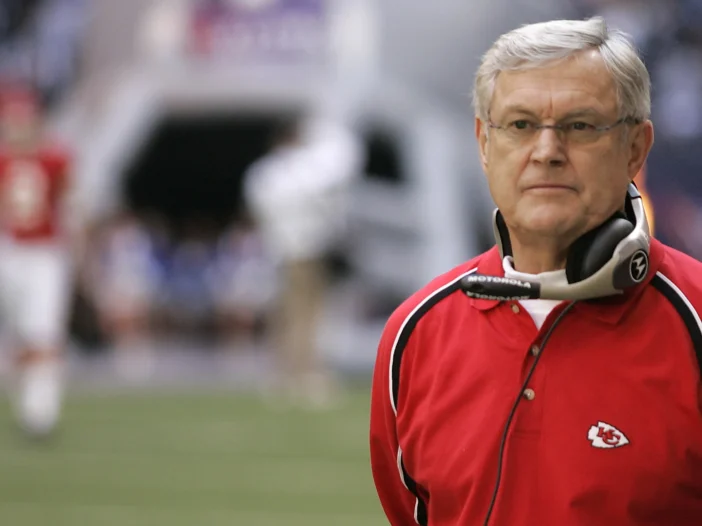
Dick Vermeil is the NFL coach who cried at press conferences, and won a Super Bowl. In a league that rewards stoicism, Vermeil’s emotional authenticity wasn’t a weakness. It was his greatest weapon. He built locker rooms on trust, loyalty, and an almost obsessive commitment to preparation, and the hardware followed.
From transforming the Philadelphia Eagles into NFC Champions in 1980 to orchestrating one of the greatest underdogs runs in NFL history with the St. Louis Rams in 1999, Vermeil’s career spans six decades of football. He returned from a 15-year burnout-induced retirement to win a Super Bowl. He turned an undrafted grocery store clerk named Kurt Warner into an NFL MVP. And he was inducted into the Pro Football Hall of Fame in 2022.
This is the complete Dick Vermeil biography, his childhood, his coaching journey, his Super Bowl triumph, his business ventures, and his life today as one of football’s most sought-after leadership speakers.
Quick Facts About Dick Vermeil
| Detail | Information |
| Date of Birth | October 30, 1936 |
| Birthplace | Calistoga, California |
| Nationality | American |
| Education | San Jose State University |
| Net Worth (est.) | $20 million |
| Spouse | Carol Vermeil (m. 1958) |
| Children | 3 |
| Occupation | Retired NFL Head Coach, Pro Football Hall of Famer, Leadership Speaker, Winery Co-Owner |
Early Life and Background
Richard Albert Vermeil was born on October 30, 1936, in the small wine country town of Calistoga, California, nestled in Napa Valley. He grew up in a working-class family with deep roots in the region, roots he would return to later in life when he co-founded Vermeil Wines.
His father, Al Vermeil, was an auto mechanic who worked long hours and instilled in Dick a blue-collar work ethic that never left him. Family was everything in the Vermeil household, and that value system would define every coaching staff Dick ever assembled.
Vermeil attended Napa High School, where he excelled as a multi-sport athlete. He later enrolled at Napa Junior College before transferring to San Jose State University, where he played quarterback. He was not a blue-chip recruit. He was a grinder, the kind of player who maximized every ounce of talent through preparation and film study.
His football instincts were evident early. Even as a player, teammates recalled that Vermeil could break down a defense like a coach. After graduating from San Jose State, he wasted no time getting on the sideline.

Career Beginnings: From High School Sidelines to the Rose Bowl
Vermeil began his coaching career at the high school level, working his way through California’s coaching pipeline with methodical patience. He served as an assistant at Hillsdale High School in San Mateo before moving into the college ranks.
His college coaching career accelerated through the late 1960s and early 1970s. He served as an assistant at San Jose State, Stanford, and UCLA, developing a reputation as a meticulous offensive coach who outworked everyone in the building. His coaching tree would eventually include some of the NFL’s best minds.
In 1974, Vermeil was named head coach at UCLA. In just his second season, 1975, he led the Bruins to a Rose Bowl appearance, a remarkable achievement that put him firmly on the NFL’s radar.
His success at UCLA was powered by the same formula he’d carry to the pros: exhaustive preparation, genuine relationships with players, and a refusal to accept mediocrity. He was not yet 40 years old, and the NFL was calling.
Philadelphia Eagles (1976–1982): Building a Winner from Nothing
In 1976, the Philadelphia Eagles were one of the NFL’s most dormant franchises, a team that hadn’t posted a winning record in over a decade. Owner Leonard Tose hired the 39-year-old Vermeil as head coach, gambling on a college coach with no NFL experience.
The gamble paid off, slowly, then spectacularly.
Turning Around a Franchise
Vermeil’s early years in Philadelphia were defined by grinding, incremental improvement. He installed a culture of accountability that the Eagles locker room had never experienced. Players who weren’t willing to commit fully to the process were shown the door.
By 1978, the Eagles had their first winning season in years. By 1979, they were playoff contenders. Vermeil’s coaching staff, including offensive coordinator Sid Gillman, helped develop quarterback Ron Jaworski into one of the NFC’s elite signal-callers.
Super Bowl XV: NFC Champions
The 1980 Philadelphia Eagles were one of the finest teams in football. Running back Wilbert Montgomery was dominant, Jaworski was sharp, and the defense was suffocating. The Eagles won the NFC Championship and advanced to Super Bowl XV in New Orleans.
They lost to the Oakland Raiders, 27–10, in a game that still stings Eagles fans. But the achievement, taking a franchise from the bottom of the league to the Super Bowl in four seasons, cemented Vermeil’s reputation as one of the best coaches in football.
Burnout and Retirement
The relentless work pace caught up with Vermeil. He was famously the first to arrive at the facility and the last to leave, sleeping on a cot in his office during the season. In 1982, after the Eagles’ season ended, Vermeil announced his retirement. He was 45 years old.
He cited burnout as the reason, a word rarely used in football circles at the time. His honesty about mental and emotional exhaustion was both vulnerable and ahead of its time.
The Comeback: St. Louis Rams and the Greatest Show on Turf (1997–1999)
For 15 years, Vermeil stayed away from coaching. He worked as a CBS and ABC football analyst, stayed connected to the game without the grind, and allowed himself to recover. Many assumed his coaching career was over.
In 1997, the St. Louis Rams came calling. They were one of the worst teams in the NFL, a franchise that had won just 3 games the previous season and was hemorrhaging fans. Vermeil, then 60 years old, said yes.
Year One: Losing, But Building
The 1997 Rams went 5–11. The 1998 Rams went 4–12. Critics questioned the hire. Vermeil was patient. He was building culture, not just winning games.
1999: The Greatest Show on Turf
The 1999 NFL season produced one of the most improbable stories in sports history. Starting quarterback Trent Green tore his ACL in the preseason. Into the lineup stepped Kurt Warner, an undrafted quarterback who had been stocking shelves at an Iowa grocery store just years earlier.
Warner was extraordinary. Paired with running back Marshall Faulk (who won NFL MVP that year) and receivers Torry Holt, Isaac Bruce, and Az-Zahir Hakim, the Rams’ offense became the “Greatest Show on Turf”, the most electrifying offensive unit the NFL had ever seen.
The Rams finished 13–3, the best record in the NFC.
Super Bowl XXXIV: Champions
On January 23, 2000, the St. Louis Rams met the Tennessee Titans in Super Bowl XXXIV in Atlanta. The game went down to the wire. With the Rams leading 23–16, Titans receiver Kevin Dyson caught a pass at the one-yard line as time expired, and was tackled one yard short of a touchdown by linebacker Mike Jones in what became one of the most iconic plays in Super Bowl history.
Final score: St. Louis Rams 23, Tennessee Titans 16.
Dick Vermeil had his Super Bowl ring. He was named NFL Coach of the Year for the 1999 season. At the post-game press conference, he wept openly, tears of joy, relief, and vindication. The football world loved him for it.
Kansas City Chiefs (2001–2005): The Final Chapter
After winning the Super Bowl, Vermeil retired again, this time briefly. He returned in 2001 as head coach of the Kansas City Chiefs, where he coached for five seasons.
His best year in Kansas City came in 2003, when the Chiefs finished 13–3 behind quarterback Trent Green and running back Priest Holmes, who set an NFL record with 27 rushing touchdowns that season. The Chiefs fell in the divisional playoffs, but the season was a testament to Vermeil’s ability to build winning cultures wherever he coached.
Vermeil retired permanently after the 2005 season, finishing his NFL career with a record of 120–109, one Super Bowl title, and three different franchises rebuilt from mediocrity.
Dick Vermeil as a Public Speaker
Since retiring from coaching, Dick Vermeil has become one of the most sought-after leadership speakers in corporate America and the sports world.
Speaking Topics
Vermeil’s speaking engagements draw on six decades of building teams, managing people, and leading through adversity. His core topics include:
- Building winning culture from nothing, drawing on his turnarounds in Philadelphia and St. Louis
- Emotional leadership, why vulnerability and authenticity make stronger leaders, not weaker ones
- The comeback story, returning after burnout, failure, or setback with greater perspective
- Loyalty and relationships in leadership, why people perform best when they feel genuinely valued
- Sustained excellence across decades, how great organizations maintain standards through roster turnover and adversity
- Resilience and mental health, his open discussion of burnout resonates powerfully with today’s corporate audiences
Who Books Dick Vermeil?
Vermeil is booked for Fortune 500 corporate events, NFL alumni programs, leadership conferences, and motivational summits. His story, comeback, resilience, emotional intelligence, translates seamlessly from the gridiron to the boardroom.
His willingness to discuss burnout openly makes him particularly relevant to modern audiences navigating work-life balance and mental health conversations in the workplace.
Dick Vermeil Net Worth 2026
Dick Vermeil’s estimated net worth in 2026 is $20 million.
His wealth has been built across several decades and multiple income streams:
- NFL coaching salaries, spanning three franchises and nearly 15 years of active head coaching
- Broadcasting career, years as a football analyst for CBS and ABC
- Speaking fees, top-tier leadership speakers command between $50,000–$100,000 per engagement
- Vermeil Wines, the family-owned winery in Calistoga, California, which has grown into a nationally recognized brand. The wines have won critical acclaim and are sold across the country.
- Endorsements and appearances, his Pro Football Hall of Fame status and cultural brand keep him in demand
Vermeil has never been motivated primarily by money, his players and former assistants consistently describe him as someone who reinvested heavily in his staff and program. But decades of smart career management and a thriving family business have made him financially secure.
Personal Life
Dick Vermeil and his wife Carol have been married since 1958, a marriage of over 65 years that has weathered the pressures of NFL coaching, burnout, retirement, and comeback with remarkable grace.
The couple has three children and have remained based in Calistoga, California, close to their roots and their winery. Carol has been a steady, grounding presence throughout Dick’s career, and he has publicly credited her with helping him navigate the darkest periods of his burnout.
Faith and family are at the center of Vermeil’s public identity. He speaks often about gratitude, relationships, and the importance of investing in people, values visible in both his personal life and his coaching philosophy.
The winery, Vermeil Wines, is a family operation that Dick co-runs with passion. Located in Napa Valley, it has become a meaningful second chapter, combining his love of California wine country with the same commitment to quality he brought to football.
Dick Vermeil Best Quotes
1. On emotional leadership: “I don’t think there’s any weakness in showing emotions. I think the people who hold it in, that’s where you have problems.”, Vermeil said this in response to critics who questioned his emotional displays on the sideline and in press conferences throughout his career.
2. On the Super Bowl comeback: “I left the game in 1982 because I felt I owed it to myself and my family. I came back in 1997 because I felt I owed it to football. The Super Bowl was for both.”, Reflecting on his return to coaching after 15 years away.
3. On Kurt Warner: “Kurt Warner is the greatest story I’ve ever been a part of, in football or in life. I just tried not to get in the way.”, On the 1999 season that changed both their lives.
4. On building culture: “You can’t buy loyalty. You can’t demand it. You have to earn it. And you earn it by caring about people more than you care about winning.”, A recurring theme in his leadership speaking engagements.
5. On burnout: “I didn’t quit football. Football quit me, temporarily. I just had enough sense to listen.”, On his 1982 retirement and the importance of knowing your limits.
6. On preparation: “The only way I knew how to coach was all the way. Every hour of every day. That’s what it costs. The question is whether you’re willing to pay it.”, Describing the relentless work ethic that defined his coaching career.
7. On the final tackle at Super Bowl XXXIV: “When Mike Jones made that tackle, I felt like every sleepless night, every early morning, every sacrifice was justified in one second. One yard. That’s football.”, Reflecting on the iconic final play of Super Bowl XXXIV.
8. On legacy: “I don’t want to be remembered for wins and losses. I want to be remembered as someone who cared about the people he coached.”, In a 2022 interview following his Pro Football Hall of Fame induction.
Frequently Asked Questions
Dick Vermeil is a retired NFL head coach and Pro Football Hall of Fame inductee who led the Philadelphia Eagles to Super Bowl XV and the St. Louis Rams to the Super Bowl XXXIV championship. Born October 30, 1936, in Calistoga, California, Vermeil is also known as a leadership speaker, former CBS and ABC football analyst, and co-owner of Vermeil Wines in Napa Valley.
Yes. Dick Vermeil won Super Bowl XXXIV with the St. Louis Rams on January 23, 2000, defeating the Tennessee Titans 23–16 in Atlanta. It capped one of the greatest single-season turnarounds in NFL history, as Vermeil had inherited a Rams team that won just 3 games two seasons earlier. He was named NFL Coach of the Year for the 1999 season.
Yes. Dick Vermeil was inducted into the Pro Football Hall of Fame in 2022, the centennial class. He was selected in recognition of his coaching career across three NFL franchises, the Philadelphia Eagles, St. Louis Rams, and Kansas City Chiefs, along with his Super Bowl XXXIV championship and his overall record of 120–109 as an NFL head coach.
Dick Vermeil’s net worth is estimated at approximately $20 million as of 2026. His wealth comes from his NFL coaching salary across three decades, his years as a broadcast analyst for CBS and ABC, speaking fees (estimated at $50,000–$100,000 per engagement), and his co-ownership of Vermeil Wines, a critically acclaimed Napa Valley winery he operates with his family in Calistoga, California.
Dick Vermeil speaks about leadership, resilience, and building winning cultures. His signature topics include emotional leadership, overcoming burnout, making comebacks after failure, and creating loyalty-driven organizations. He is frequently booked for corporate leadership events, NFL alumni programs, and motivational conferences. His openness about mental health and burnout makes him especially relevant to modern business audiences.
Conclusion
The Dick Vermeil biography is ultimately a story about what happens when talent meets relentlessness, and what happens when relentlessness meets its limit. Vermeil built three franchises, won a Super Bowl, and shaped the careers of hundreds of players and coaches. He also burned out, stepped away, and came back stronger. His career is a master class in building culture, leading with emotional intelligence, and proving that second acts don’t just happen, they’re earned.
From a working-class childhood in Calistoga to the Pro Football Hall of Fame, Dick Vermeil has lived one of the great American sports stories. At 88 years old, he continues to share its lessons with the next generation of leaders.
Leave a Reply