
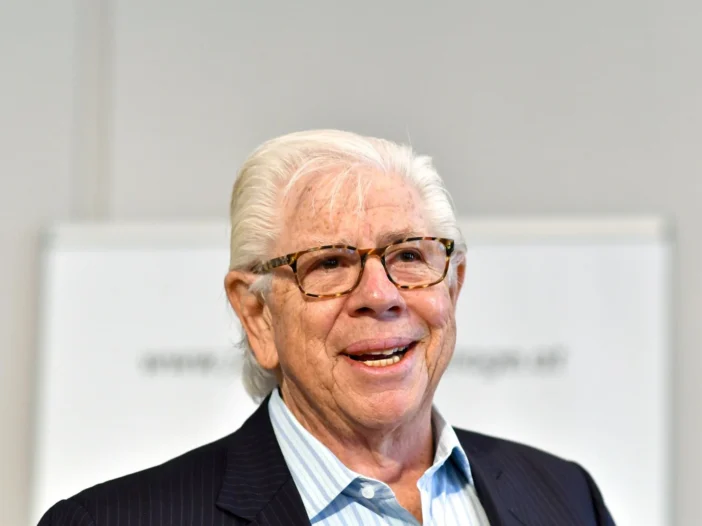
At 28 years old, Carl Bernstein helped bring down the most powerful man in the world. Working alongside Bob Woodward at The Washington Post, Bernstein co-reported the Watergate scandal, a story that forced President Richard Nixon to resign on August 9, 1974, and permanently redefined what journalism could accomplish. Born February 14, 1944, in Washington, D.C., Bernstein’s path from college dropout to Pulitzer Prize winner to global media icon is one of the great self-made stories in American public life. He has written landmark books, appeared as a CNN political analyst for decades, married three times, and become one of the most in-demand public speakers on journalism and democracy. This is the complete Carl Bernstein biography, covering his early life, Watergate reporting, books, personal life, net worth, and legacy.
Quick Facts About Carl Bernstein
| Detail | Information |
| Date of Birth | February 14, 1944 |
| Birthplace | Washington, D.C., USA |
| Nationality | American |
| Education | University of Maryland (did not graduate) |
| Occupation | Journalist, Author, CNN Analyst, Public Speaker |
| Known For | Watergate investigation, All the President’s Men |
| Net Worth (est.) | $16 million |
| Spouse / Partner | Currently with Christine DeLury |
| Children | Two sons (Jacob and Max Bernstein, with Nora Ephron) |
Early Life and Background
Carl Bernstein was born into a politically aware Jewish family in Washington, D.C., on Valentine’s Day, 1944. His parents, Alfred and Sylvia Bernstein, were labor activists, an upbringing that shaped his instinct to question authority and speak truth to power.
He attended the University of Maryland but dropped out in 1964 before completing his degree. It’s a biographical footnote that has become almost legendary in journalism circles: one of the most celebrated reporters in American history never earned a college diploma.
What he lacked in formal credentials, he made up for in hustle. At just 16 years old, Bernstein landed a job as a copyboy at The Washington Star, beginning a newspaper career that would stretch across more than six decades. He later worked at The Elizabeth Daily Journal in New Jersey before joining The Washington Post in 1966.

Career Beginnings
Bernstein’s early years at The Washington Post were unspectacular by design. He was a general-assignment reporter, building skills, cultivating sources, and learning the rhythms of Washington’s political machinery.
Editors at the Post considered him talented but undisciplined, a reporter whose instincts outpaced his attention to administrative detail. His writing, however, was sharp and his source work was extraordinary. Those qualities would matter enormously when, in the summer of 1972, history came knocking.
The assignment that changed everything landed quietly. On June 17, 1972, five men were arrested for breaking into the Democratic National Committee headquarters at the Watergate complex in Washington, D.C. Bernstein was assigned, alongside a younger reporter named Bob Woodward, to follow up on what initially looked like a minor burglary.
Major Career Highlights
Watergate: The Investigation That Toppled a Presidency
What Bernstein and Woodward uncovered went far beyond a burglary. Through months of relentless reporting, guided in part by a mysterious senior FBI source both men would call “Deep Throat” (later revealed in 2005 to be Mark Felt, then-Associate Director of the FBI), the two reporters exposed a coordinated campaign of political espionage, illegal wiretapping, and a White House cover-up that reached directly to President Nixon himself.
Their coverage earned The Washington Post the Pulitzer Prize for Public Service in 1973, journalism’s highest honor. Nixon, facing near-certain impeachment, resigned on August 9, 1974. It remains the only resignation of a sitting U.S. president in history.
Key facts from the Watergate reporting:
- Bernstein and Woodward published their first Watergate story on June 19, 1972, two days after the break-in
- They confirmed that the break-in was connected to Nixon’s Committee to Re-Elect the President (CREEP)
- Their reporting revealed the existence of a White House “enemies list” and illegal surveillance operations
- The investigation spanned two years of sustained daily reporting under significant political pressure
All the President’s Men (1974)
In 1974, Bernstein and Woodward published All the President’s Men, their first-person account of the Watergate investigation. The book became an instant bestseller and is widely considered one of the most important works of American journalism ever written.
In 1976, the story was adapted into a feature film starring Robert Redford as Woodward and Dustin Hoffman as Bernstein. The film was nominated for eight Academy Awards and won four, including Best Supporting Actor for Jason Robards as Washington Post editor Ben Bradlee. The film cemented Bernstein’s place in the American cultural imagination.
The Final Days (1976)
Bernstein and Woodward followed their debut with The Final Days, a detailed reconstruction of Nixon’s last months in office. Based on hundreds of interviews conducted after Nixon’s resignation, the book provided a vivid, scene-by-scene account of the White House in collapse. Critics called it a masterpiece of narrative reporting.
Later Books and Major Works
Bernstein’s bibliography extends well beyond Watergate:
- Loyalties: A Son’s Memoir (1989), a personal account of his parents’ left-wing political activities during the McCarthy era and how those years shaped the family
- His Holiness: John Paul II and the Hidden History of Our Time (1996), co-authored with Marco Politi; a critically acclaimed biography of Pope John Paul II exploring the pontiff’s role in the fall of communism in Eastern Europe
- A Woman in Charge: The Life of Hillary Rodham Clinton (2007), a deeply reported biography of Hillary Clinton that drew on extensive interviews and archival research
CNN and Broadcast Career
Beyond print, Bernstein has maintained a prominent television presence for decades. He joined ABC News in the late 1970s and later became a contributing editor at Time magazine.
Since 2017, his role at CNN has placed him at the center of major political coverage, including the Trump presidency, the Mueller investigation, and the January 6, 2021 Capitol riot. His analysis draws directly on his half-century of covering Washington, giving him a credibility, few television commentators can match.
Carl Bernstein as a Public Speaker
Carl Bernstein is among the most sought-after public speakers in the fields of journalism, democracy, and American political history. His speaking topics draw on more than 55 years of front-row access to the most powerful institutions in the United States.
Core speaking topics include:
- Watergate and its relevance to American democracy today
- The role of a free press in holding government accountable
- Investigative journalism: methods, ethics, and impact
- Covering Washington across five decades of political change
- The media landscape in the digital age
- Lessons from the Nixon era for contemporary political leadership
Bernstein is regularly booked by:
- University journalism schools and communications programs
- Media industry conferences and press freedom organizations
- Civic organizations, bar associations, and business leadership groups
- Political science departments and history conferences
He commands among the highest speaking fees of any working American journalist. Engagements typically include a keynote address followed by a moderated Q&A, drawing on his personal experience as one of the reporters who reshaped the relationship between press and political power.
Carl Bernstein Net Worth 2026
Carl Bernstein’s estimated net worth in 2026 is approximately $16 million. That figure reflects a career built across multiple revenue streams over more than five decades.
Primary income sources include:
- Book royalties, All the President’s Men has remained in print continuously since 1974 and continues to generate substantial royalties
- Film royalties, the 1976 Warner Bros. film adaptation of All the President’s Men has contributed ongoing licensing income
- CNN contracts, Bernstein’s long-running role as a CNN political analyst represents a significant and consistent income stream
- Speaking fees, commanding top-tier rates for keynotes and appearances at media, civic, and academic events
- Magazine and editorial work, decades of contributing journalism to major publications
His wealth is the product of sustained, multi-decade career output rather than any single transaction, a pattern consistent with the careers of America’s most enduring journalistic voices.
Personal Life
Carl Bernstein has been married three times. His first marriage ended in divorce. His second, and most publicly discussed, was to writer and filmmaker Nora Ephron, whom he married in 1976.
The Ephron marriage produced two sons, Jacob and Max Bernstein, but ended acrimoniously after Bernstein had an affair while Ephron was pregnant with their second child. Ephron transformed the experience into her 1983 semi-autobiographical novel Heartburn, which was adapted into a 1986 film directed by Mike Nichols and starring Meryl Streep and Jack Nicholson. The novel’s thinly veiled portrait of Bernstein as a serially unfaithful husband was widely read and discussed.
His third marriage also ended in divorce. He has since been in a long-term relationship with Christine DeLury.
Bernstein is known to be close to his sons, both of whom have pursued careers in the arts and media. He has spoken publicly about the influence of his parents’ political convictions on his own worldview, a theme he explored directly in Loyalties: A Son’s Memoir.
He continues to live and work in the New York area, where he remains an active journalist and commentator.
Carl Bernstein Best Quotes
On Watergate and journalism:
“The lowest form of popular culture, lack of information, misinformation, disinformation, and a contempt for the truth or the reality of most people’s lives, has overrun real journalism.”, Bernstein on media standards and democratic accountability
“The best obtainable version of the truth.”, Bernstein’s oft-repeated definition of what journalism should be
On the Nixon presidency:
“Nixon was the most dishonest individual I have ever met in my life. He lied to his wife, his family, his friends, his colleagues in the Congress, lifetime members of his own political party, the American people, and the world.”, Bernstein in a 2017 interview reflecting on his Watergate reporting
On the free press:
“Reporters are not supposed to be stenographers. We are supposed to get the best obtainable version of the truth and get it to the public.”, Bernstein at a journalism conference on the role of the press
On President Trump (a notable example of his CNN commentary):
“The real story is that ‘the family,’ as I’ve been calling it, meaning Jared and Ivanka, have gone to the generals to try to tell them that the President is out of control.”, Bernstein in a 2017 CNN appearance, illustrating his sourcing-driven approach to political reporting
On his own career:
“I was a college dropout who got hired as a copy boy and became a reporter. That path doesn’t exist as easily today, and that’s a loss for journalism.”, Bernstein on access to journalism as a career
On democracy:
“This is a constitutional crisis unlike anything we have seen since Watergate. The President of the United States is lying to the American people.”, Bernstein during CNN coverage of the Trump-Ukraine controversy, 2019
Frequently Asked Questions
Carl Bernstein is an American investigative journalist, author, and CNN political analyst born on February 14, 1944, in Washington, D.C. He is best known for co-reporting the Watergate scandal alongside Bob Woodward for The Washington Post in 1972–74, work that contributed to President Nixon’s resignation and earned the paper a Pulitzer Prize for Public Service. He is also the co-author of All the President’s Men.
Working alongside Bob Woodward, Bernstein investigated the 1972 break-in at the Democratic National Committee headquarters at the Watergate complex. Over two years, the pair exposed a White House cover-up, illegal surveillance operations, and a political sabotage campaign tied directly to President Nixon. Their reporting, guided partly by the anonymous source “Deep Throat”, led directly to Nixon’s resignation on August 9, 1974, the only presidential resignation in U.S. history.
Carl Bernstein’s estimated net worth in 2026 is approximately $16 million. His wealth comes from multiple sources built over more than five decades: CNN analyst contracts, royalties from All the President’s Men and his other books, film royalties from the 1976 Warner Bros. movie adaptation, high-demand public speaking engagements, and decades of magazine and editorial work. He is considered one of the wealthiest and most financially successful journalists of his generation.
Carl Bernstein has been married three times. His most famous marriage was to writer and director Nora Ephron (married 1976, divorced 1980), with whom he has two sons, Jacob and Max. Ephron fictionalized their marriage, and Bernstein’s infidelity, in her 1983 novel Heartburn, later adapted into a film with Meryl Streep. Bernstein was previously married once before Ephron and once after, and is currently in a long-term relationship with Christine DeLury.
Carl Bernstein speaks on topics including Watergate and its lessons for American democracy, the history and future of investigative journalism, press freedom and the First Amendment, holding presidential power accountable, and his five decades covering Washington, D.C. He is regularly booked by university journalism programs, media industry conferences, and civic organizations. His speaking fee places him among the top tier of American political and journalism speakers.
Conclusion
Few figures in American public life can claim the combined cultural, political, and journalistic impact of Carl Bernstein. From a teenage copyboy at The Washington Star to Pulitzer Prize winner, bestselling author, and CNN’s most historically grounded political voice, his life is a masterclass in the power of relentless reporting. The Carl Bernstein biography is ultimately a story about what journalism can do when it refuses to look away, and what is at stake when it does. His work on Watergate didn’t just end a presidency; it established the standard by which investigative journalism has been measured ever since.
Leave a Reply