
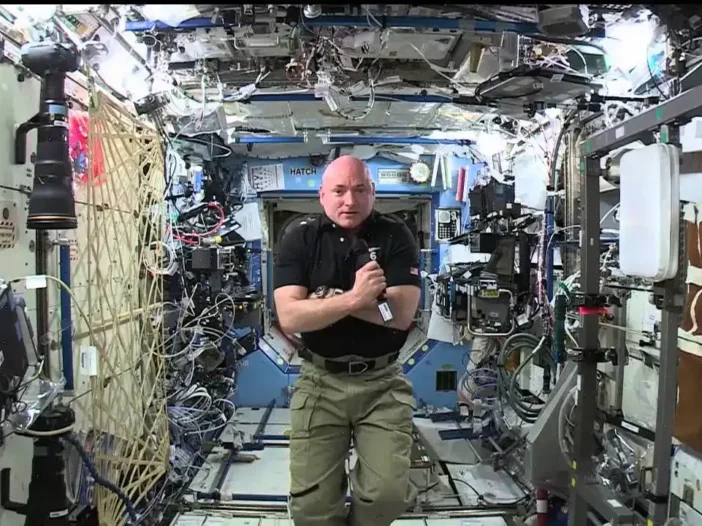
Scott Kelly once failed out of his own ambitions, a self-described bad student who drifted through his early college years with no direction. Then he picked up a copy of Tom Wolfe’s The Right Stuff, and everything changed. What followed was one of the most extraordinary careers in American space history: four space missions, 520 total days in orbit, and a record-setting 340 consecutive days aboard the International Space Station that made Kelly the subject of one of NASA’s most important scientific studies ever conducted. Born February 21, 1964, in Orange, New Jersey, this is the complete Scott Kelly biography, the man, the mission, and the message he now carries to boardrooms and auditoriums across America.
Quick Facts About Scott Kelly
| Category | Details |
| Date of Birth | February 21, 1964 |
| Birthplace | Orange, New Jersey, USA |
| Nationality | American |
| Height | 6’0″ (183 cm) |
| Education | B.S., State University of New York Maritime College; M.S., University of Tennessee |
| Estimated Net Worth | $5 million (2026) |
| Spouse / Partner | Amiko Kauderer Kelly |
| Children | 2 daughters (from a previous relationship) |
| Occupation | Retired NASA Astronaut, Author, Public Speaker |
| Notable Work | ISS Year in Space (2015–2016), Endurance (2017) |
Early Life and Background
Scott Kelly grew up in Orange, New Jersey, in a working-class household alongside his identical twin brother, Mark Kelly. By his own admission, Scott was a poor student, easily distracted, academically adrift, and showing few signs of the extraordinary discipline that would later define him.
That changed during his freshman year at the State University of New York Maritime College. Kelly stumbled across Tom Wolfe’s The Right Stuff, a narrative account of the Mercury astronauts and the test pilots who became America’s first heroes of the space age. He read it in one sitting.
The book didn’t just inspire him, it rewired his identity overnight. Kelly decided, with sudden and absolute clarity, that he wanted to fly jets, break barriers, and go to space. He overhauled his academic habits, pushed himself through SUNY Maritime with new purpose, and set his sights on the U.S. Navy.
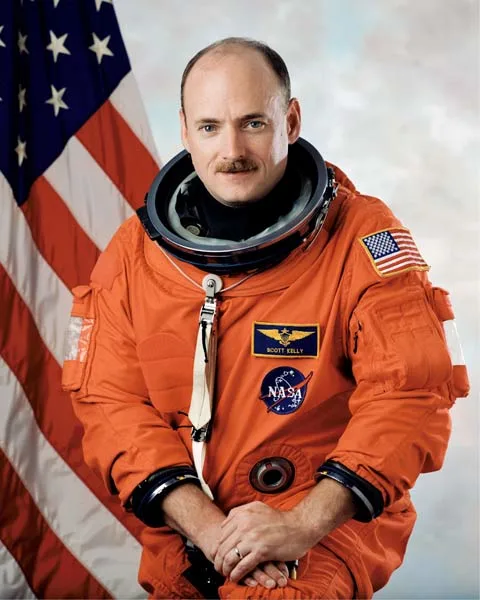
Career Beginnings, From Mediocre Student to Fighter Pilot
After graduating from SUNY Maritime with a Bachelor of Science in Electrical Engineering in 1987, Kelly joined the U.S. Navy and trained as an aviator. He proved to be a natural in the cockpit.
Kelly flew the F-14 Tomcat, one of the most demanding carrier-based fighter jets ever built, and logged combat missions during Operation Southern Watch, enforcing the no-fly zone over Iraq in the 1990s. His performance as a naval aviator earned him a coveted slot at the U.S. Naval Test Pilot School at Patuxent River, Maryland.
Graduating from test pilot school placed Kelly among the military’s elite. He went on to earn a Master of Science in Aviation Systems from the University of Tennessee, and in 1996, NASA selected him as an astronaut candidate, exactly the kind of high-stakes career arc he had dreamed about reading The Right Stuff on his dorm room bed years earlier.
Major Career Highlights
Scott Kelly’s NASA career spanned two decades and included four spaceflight missions, each adding to a legacy that would ultimately reshape what we understand about long-duration human spaceflight.
STS-103, First Spaceflight (1999)
Kelly’s first mission came as pilot of Space Shuttle Discovery on STS-103 in December 1999. The crew was tasked with servicing the Hubble Space Telescope, one of NASA’s most critical and high-profile repair missions. The flight lasted 8 days, 21 hours, and 20 minutes.
STS-118, Commander of Endeavour (2007)
In August 2007, Kelly commanded Space Shuttle Endeavour on STS-118, a construction and resupply mission to the International Space Station. The mission delivered the S5 truss segment to the ISS and logged 12 days, 17 hours, and 55 minutes in orbit. Kelly’s command marked a significant milestone in his evolution from pilot to mission leader.
ISS Expedition 25/26, First Long-Duration Mission (2010–2011)
Kelly returned to the ISS as commander of Expedition 26, spending approximately 159 days aboard the station between October 2010 and March 2011. This mission gave him his first deep experience with the physical and psychological demands of long-duration spaceflight, and planted the seed for what would become his defining mission.
The Year in Space, Expedition 43/44/45/46 (2015–2016)
This is the mission that changed everything.
The Year in Space, Scott Kelly’s Record-Breaking Mission
On March 27, 2015, Scott Kelly launched from the Baikonur Cosmodrome in Kazakhstan aboard a Soyuz spacecraft, beginning what would become the longest single spaceflight ever completed by an American astronaut.
For 340 consecutive days, Kelly lived and worked aboard the International Space Station, conducting science experiments, performing spacewalks, and managing the psychological marathon of isolation that defines life 250 miles above Earth.
He returned to Earth on March 1, 2016, having logged 340 days, 8 hours, and 42 minutes in space on that mission alone. Over his entire career, his total time in space reached 520 days.
The NASA Twin Study
What made Kelly’s year in space uniquely historic was what happened simultaneously on Earth. His identical twin brother, Senator Mark Kelly, remained on the ground, providing NASA with a living biological control group.
The NASA Twin Study monitored more than 10 physiological and biological markers in both brothers over the course of the year, including:
- Gene expression and epigenetic changes
- Cognitive performance and reaction time
- Gut microbiome composition
- Telomere length (which actually lengthened in Scott during spaceflight, and then shortened after return)
- Cardiovascular health
- Immune system response
The results, published in science in 2019, revealed that more than 91% of Scott’s gene expression changes returned to normal within six months of landing. The study is now considered one of the most comprehensive human health studies ever conducted in space medicine, and its findings will shape planning for future missions to Mars.
Endurance, Scott Kelly’s Bestselling Memoir
In 2017, Kelly published, a memoir covering not just the 340-day mission but the entire arc of his life, from the aimless student to the astronaut who flew farther and longer than any American before him.
The book became a New York Times bestseller and is widely praised for its combination of technical depth and emotional honesty. Kelly writes with unusual frankness about:
- The physical deterioration of the human body in microgravity
- The psychological weight of isolation and confinement
- The extraordinary teamwork required to keep the ISS functioning
- His complicated, admiring, and competitive relationship with twin brother Mark
Endurance is now used in leadership curricula at universities and corporate training programs across the country, a testament to how universally applicable Kelly’s lessons from space have proven to be.
Scott Kelly as a Public Speaker
Scott Kelly is one of the most in-demand speakers to emerge from the American astronaut corps, and for good reason. His story combines extreme-environment leadership, scientific significance, and a personal redemption arc that resonates across industries.
Scott Kelly’s Speaking Topics
Kelly’s keynotes are built around themes that translate directly to corporate, healthcare, and academic audiences:
- Leadership under pressure, how decision-making works when the margin for error is zero
- Resilience and adaptation, sustaining performance over long, gruelling timelines
- Embracing the unknown, how curiosity and preparation intersect in exploration
- Teamwork across cultures, working alongside Russian cosmonauts during geopolitical tensions
- Human performance, what the Twin Study taught us about optimizing the human body and mind
- Change management, applying space-mission thinking to organizational transformation
Who Books Scott Kelly?
Kelly’s audiences are typically Fortune 500 executives, healthcare system leaders, university commencement ceremonies, and government leadership programs. His story bridges the worlds of science, military service, and personal reinvention in a way that few speakers can.
His Scott Kelly age (61 in 2025) and decades of lived experience lend weight and credibility to every theme he addresses, this is not motivational speaking by someone recounting a good climb or a difficult marathon. It is testimony from a man who spent nearly a year in one of the most hostile environments ever endured by a human being.
Scott Kelly Net Worth 2026
Scott Kelly’s estimated net worth in 2026 is $5 million, built across several distinct income streams over his career.
Income Sources
- NASA Salary and Pension: Kelly retired from NASA as a senior astronaut with a government pension reflecting more than two decades of federal service
- Book Royalties: Endurance (2017) reached the New York Times bestseller list and continues to generate royalty income; he also co-authored My Journey to the Stars (2017), a children’s adaptation
- Keynote Speaking Fees: Industry estimates place Scott Kelly’s speaking fee in the range of $50,000–$100,000 per engagement
- Media and Television: Appearances on major news networks, documentaries, and streaming platforms contribute to his public profile and income
- Philanthropy and Advocacy: Kelly auctioned his personal watch collection in 2022 to raise funds for Ukrainian refugees, a high-profile act of advocacy that also underscored his values
Kelly’s Scott Kelly net worth reflects a carefully built post-NASA brand rooted in credibility, not celebrity.
Personal Life
Scott Kelly married Amiko Kauderer Kelly, a former NASA public affairs officer, and the couple is based in Tucson, Arizona. Amiko maintained a visible public presence during Kelly’s year-in-space mission, frequently communicating with media on his behalf.
Kelly has two daughters from a previous relationship. He is known for being a devoted father who has spoken publicly about the particular challenge of parenting from the ISS, watching his daughters grow over a year’s worth of video calls from 250 miles above Earth.
His twin brother, Mark Kelly, was elected to the U.S. Senate representing Arizona in 2020, making the Kelly brothers arguably the most accomplished sibling pair in American public life: one a sitting U.S. Senator, the other a holder of the American record for consecutive days in space.
Scott Kelly has been vocal in his support for Ukrainian democracy, speaking out against the Russian invasion and channeling personal resources toward humanitarian aid. He has also been an advocate for science education and STEM outreach, frequently visiting schools and youth programs.
Scott Kelly’s Best Quotes
Here are eight quotes that capture Kelly’s philosophy on endurance, leadership, and the human capacity to push beyond limits.
1. On the transformative power of reading:
“One book changed my life. It made me realize that people aren’t born great, they become great.” Kelly often opens keynotes with this reflection on discovering The Right Stuff, framing it as a lesson in how quickly a single encounter with the right idea can alter a life’s trajectory.
2. On embracing difficult missions:
“The most rewarding things in life are usually the hardest ones. Space is the ultimate proof of that.” From a 2017 interview following the publication of Endurance, Kelly spoke about why he volunteered for the year-in-space mission despite knowing its physical costs.
3. On leadership under pressure:
“When everything is at stake, you don’t rise to the occasion, you fall to the level of your training. So train like your life depends on it, because someday it might.” A recurring theme in his corporate keynotes, Kelly draws on the ISS’s no-margin-for-error environment to make the case for deep, consistent preparation.
4. On isolation and mental resilience:
“There were days in space when I had to actively choose optimism. It wasn’t automatic. But I learned that you can train your mind the same way you train your body.” Shared in interviews discussing the psychological demands of the 340-day mission.
5. On teamwork across differences:
“I shared a spacecraft with cosmonauts during the worst U.S.-Russia relations since the Cold War. We had a job to do, and we did it. That’s a lesson Earth could use.” Kelly has used this observation frequently in speeches about collaboration and diplomacy.
6. On the view from space:
“When you see the Earth from 250 miles up, borders disappear. All you see is one fragile, connected world. That perspective changes you permanently.” One of his most quoted observations, appearing in both Endurance and dozens of media interviews.
7. On failure and reinvention:
“I was a bad student. Not a little bad, genuinely bad. And then I wasn’t. People can change if they find the right reason to.” Kelly uses his own academic history as a counternarrative to the myth of predetermined talent.
8. On the future of human exploration:
“Mars is not a fantasy. It’s an engineering problem with a human solution. I believe people alive today will walk on that planet.” From a 2023 public lecture at the Smithsonian National Air and Space Museum.
Frequently Asked Questions
Scott Kelly spent a total of 520 days in space across his four NASA missions. His most famous mission, Expedition 43/44/45/46 aboard the International Space Station, lasted 340 consecutive days, from March 27, 2015 to March 1, 2016. That single mission set the American record for the longest continuous spaceflight and made Kelly the subject of NASA’s landmark Twin Study.
The NASA Twin Study was a scientific experiment that compared the biology of astronaut Scott Kelly, who spent a year in space, with his identical twin brother Mark Kelly, who remained on Earth. Researchers tracked over 10 biological markers including gene expression, cognition, gut microbiome, and telomere length. Results published in science in 2019 showed most changes reversed after Scott’s return, providing critical data for future long-duration missions.
Yes, Scott Kelly and Mark Kelly are identical twins. Mark Kelly is a retired NASA astronaut and a U.S. Senator representing Arizona, elected in 2020. The brothers flew separate Space Shuttle missions and were both selected in the same NASA astronaut class in 1996. Their unique relationship made the Twin Study possible and remains one of the most famous sibling stories in the history of American space exploration.
Scott Kelly’s estimated net worth is approximately $5 million as of 2026. His wealth comes from his NASA career pension, royalties from his New York Times bestselling memoir Endurance and his children’s book My Journey to the Stars, and keynote speaking fees estimated at $50,000–$100,000 per event. He has also been involved in media projects and has raised funds through personal charity auctions benefitting Ukrainian refugees.
Scott Kelly’s keynotes focus on leadership, resilience, and human performance under extreme conditions. Drawing on his year aboard the International Space Station, he covers topics including decision-making with zero margin for error, sustaining performance through isolation and adversity, cross-cultural teamwork, change management, and scientific curiosity. His audiences include Fortune 500 companies, healthcare systems, military organizations, and university commencements across the United States.
Conclusion
From a disengaged college student who found direction in a paperback book to the American record-holder for consecutive days in space, the Scott Kelly biography is one of the most compelling stories in modern American life. He didn’t just survive a year in space, he emerged from it as a scientist’s subject, a bestselling author, a leadership speaker, and an advocate for human dignity on Earth. His twin study data will guide the planning of Mars missions for decades. His Endurance memoir will remain required reading in corporate training rooms long after the headlines fade. And his keynotes will keep reminding audiences in boardrooms and lecture halls across America that preparation, curiosity, and the willingness to endure are the essential ingredients of any extraordinary life.
Leave a Reply