
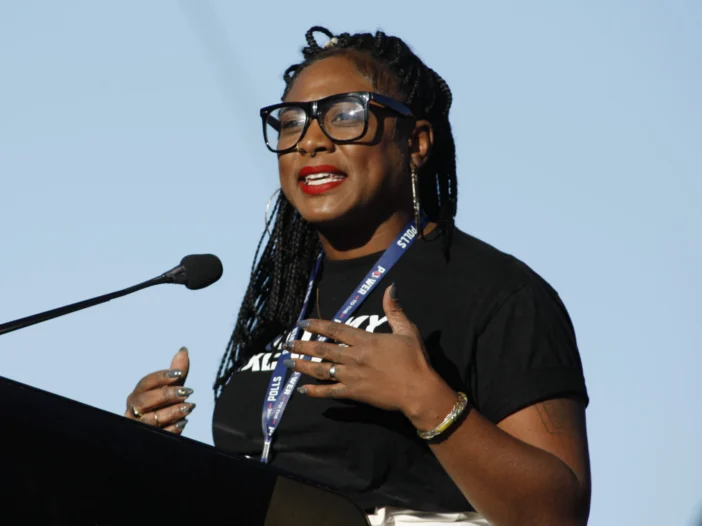
On July 13, 2013, Alicia Garza typed what she later called “a love letter to Black people” on Facebook. Minutes after George Zimmerman was acquitted in the shooting death of Trayvon Martin, her words rippled across a grieving community. Her friend Patrisse Cullors added a hashtag. Three words, #BlackLivesMatter, would ignite one of the most consequential social movements in modern American history.
Born January 4, 1981, in Oakland, California, Garza is a writer, strategist, organizer, and co-founder who has spent her adult life building political power for marginalized communities. Far more than a hashtag creator, she is a trained community organizer, a bestselling author, and a sought-after public speaker whose work stretches from housing rights to domestic workers to national electoral strategy.
This complete Alicia Garza biography covers her early life, career, the founding of Black Lives Matter, her books, net worth, speaking topics, and personal life.
Quick Facts About Alicia Garza
| Category | Detail |
| Date of Birth | January 4, 1981 |
| Birthplace | Oakland, California, USA |
| Birth Name | Alicia Schwartz |
| Nationality | American |
| Education | B.A., Anthropology & Sociology, UC San Diego (2002) |
| Occupation | Activist, Author, Organizer, Public Speaker |
| Known For | Co-founding Black Lives Matter (2013) |
| Spouse | Malachi Garza (m. 2008) |
| Net Worth (Est.) | ~$3 million |
| Social Media | @aliciagarza (Twitter/X, Instagram) |
Early Life and Background
Alicia Garza was born Alicia Schwartz in Oakland, California, and raised in Marin County, an affluent, largely white suburb north of San Francisco that provided a complicated backdrop for a young mixed-race girl growing up in the 1980s and 1990s.
Her mother is Black and her stepfather is Jewish, and Garza has spoken publicly about how her biracial, interfaith household shaped her understanding of identity early in life. The family ran an antique store, and Garza grew up navigating between two cultural worlds, often finding herself as a minority in Marin County’s predominantly white spaces.
By age 12, Garza was already showing the instincts of an organizer. She helped lead a campaign at her middle school promoting sex education, an early signal of the direct-action mindset she would later build an entire career around.
A pivotal moment came in her teenage years when her brother was arrested by police. That experience made the cost of systemic racism viscerally personal and, by her own account, planted the seeds of the activist she would become.
Career Beginnings
After graduating from UC San Diego in 2002 with a degree in Anthropology and Sociology, Garza returned to the Bay Area and threw herself into professional community organizing. Her academic training gave her an analytical lens, she understood how systems worked, and more importantly, how they could be changed.
Her earliest organizing work spanned multiple interconnected issues:
- Housing justice, tenant rights and anti-displacement campaigns in the Bay Area
- Labour rights, economic equity for low-wage workers
- LGBTQ+ rights, advocacy for queer communities of colour
- Reproductive justice, healthcare access and bodily autonomy
At UC San Diego, she had already shown leadership by helping organize the first Women of Colour Conference on campus. That experience of building coalitions across different identities became a defining feature of her organizing philosophy, one she would later articulate in her book and speaking engagements.
She joined the National Domestic Workers Alliance (NDWA), eventually rising to the role of Special Projects Director, where she worked to improve conditions for the often-invisible workforce of nannies, house cleaners, and home care workers across America.
Major Career Highlights
Co-Founding Black Lives Matter (2013)
The moment that changed everything arrived on July 13, 2013; the night George Zimmerman was acquitted of all charges in the death of 17-year-old Trayvon Martin. Garza, devastated and furious, posted an emotional message to Facebook, what she described as “a love letter to Black people.”
Her friend and fellow organizer Patrisse Cullors shared the post and appended the phrase #BlackLivesMatter. A third co-founder, Opal Tometi, helped build the early digital infrastructure for the movement.
What began as a hashtag grew into a structured organization? Key milestones include:
- 2014, The police killing of Michael Brown in Ferguson, Missouri, triggered nationwide protests that catapulted Black Lives Matter into global consciousness
- 2015–2016, The BLM Global Network expanded to more than 40 chapters across the United States, Canada, the United Kingdom, and Australia
- 2020, Following the murder of George Floyd, BLM became arguably the largest protest movement in U.S. history, with an estimated 15–26 million participants in demonstrations across the country
Garza has been clear that Black Lives Matter was never meant to be a single organization but a decentralized movement framework, a distinction that has sometimes been lost in media coverage.
Black Futures Lab (2018)
After stepping back from the BLM Global Network in 2017, Garza founded the Black Futures Lab, a nonpartisan political organization dedicated to making Black communities a powerful political force. The Lab conducts original research, engages in policy advocacy, and runs civic participation campaigns, including the Black Census Project, the largest survey of Black Americans in over 150 years.
The Black Census Project gathered responses from more than 30,000 Black Americans across all 50 states, producing a landmark data set used by researchers, journalists, and policymakers.
Supermajority (2019)
In 2019, Garza co-founded Supermajority alongside Cecile Richards (former president of Planned Parenthood) and Ai-Jen Poo (Executive Director of the National Domestic Workers Alliance). The organization was built with a singular goal: mobilize 2 million women as a coordinated voting bloc ahead of the 2020 election.
Supermajority trained thousands of volunteers and focused its organizing energy on women who had never previously engaged in political action, expanding the electorate rather than simply activating the already-engaged.
The Purpose of Power (2020)
In October 2020, Garza published The Purpose of Power: How We Come Together When We Fall Apart through One World, an imprint of Random House. The book is simultaneously a memoir and a practical organizing guide, weaving together Garza’s personal story with broader lessons about how movements are built, how they sustain themselves, and how they sometimes fail.
The book became a bestseller and has since been widely adopted in university curricula, appearing on syllabi in social justice, political science, sociology, and public policy programs across the country. It remains one of the defining texts of contemporary activist literature.
Alicia Garza as a Public Speaker
Alicia Garza is one of the most in-demand speakers working at the intersection of race, power, and civic engagement in the United States today. Her speaking engagements reflect the full breadth of her career, from movement history to practical organizing strategy to corporate inclusion.
Core speaking topics include:
- The origin and evolution of the Black Lives Matter movement
- Building political power in Black and marginalized communities
- Intersectional organizing, connecting race, gender, class, and sexuality
- Movement strategy: what works and what doesn’t
- Women as a political and economic force
- The future of American democracy and civic participation
- Leadership development and organizational culture
Who books Alicia Garza?
- Universities and colleges, social justice lecture series, political science departments, Black student unions, diversity programming
- Corporate DEI programs, Fortune 500 companies, executive leadership forums, and employee resource groups
- Non-profit and foundation conferences, racial equity convenings, civic leadership summits
- Government and policy organizations, public policy institutes, legislative briefings
Garza was named to TIME Magazine’s 100 Most Influential People list in 2020, the same year her book was published and the same year the global protests following George Floyd’s death brought BLM back to the center of national conversation. Forbes has also recognized her among the most powerful women in social change.
Her presence on college campuses has been particularly notable. As a co-founder of a movement that emerged largely through youth activism, she carries both historical authority and direct relevance for student audiences grappling with political engagement.
Alicia Garza Net Worth 2026
Alicia Garza’s estimated net worth is approximately $3 million, built across multiple income streams over more than two decades of public life.
Primary income sources include:
- Speaking fees, as a TIME 100 honouree and BLM co-founder, Garza commands fees reported in the range of $30,000–$50,000 per engagement at major corporate and university events
- Book royalties, The Purpose of Power has sold steadily since its 2020 release, generating ongoing royalty income from sales, licensing, and academic adoptions
- Organizational leadership, her roles leading the Black Futures Lab and Supermajority involve executive-level compensation
- Media appearances, Television, podcast, and documentary appearances contribute additional income
- Awards and fellowships, Various civic and academic institutions have recognized her work with grant funding and fellowships
It is worth noting that Garza has spent her career primarily in the non-profit and organizing sector, not in entertainment or tech, so her net worth reflects the financial reality of a mission-driven career rather than a corporate or celebrity trajectory.
Personal Life
Alicia Garza has been married to Malachi Garza since 2008. Malachi is also an activist and organizer, and the two are based in the Oakland, California area, the same community where Alicia was born and to which she has remained deeply connected throughout her career.
Garza publicly identifies as queer, and she has spoken openly about how her experience as a queer Black woman informs her organizing philosophy. She views race, gender, sexuality, and class not as separate issues but as deeply interconnected systems, a perspective she describes as intersectional feminism in practice, not just in theory.
She also acknowledges her Jewish identity alongside her Black identity, describing how her biracial, interfaith upbringing gave her an early education in navigating multiple worlds and multiple forms of belonging, and exclusion.
Her personal values are consistent with her public work: a commitment to collective action over individual achievement, a belief in the dignity of all people, and a deep suspicion of power that is not accountable to those it affects.
Alicia Garza Best Quotes
These quotes reflect the full range of Garza’s thinking, on love, power, race, and the hard work of organizing.
1. On the origin of Black Lives Matter: “Black Lives Matter is an ideological and political intervention in a world where Black lives are systematically and intentionally targeted for demise.”, From her foundational 2013 post and later writings on the movement’s purpose.
2. On love as a political act: “Trayvon Martin was our son. And then we heard… not guilty. I felt it in my bones. And then I wrote a love letter to Black people.”, Describing the emotional origins of the #BlackLivesMatter hashtag.
3. On organizing: “Organizing is not mobilizing. Mobilizing is getting people who already agree with you to do something. Organizing are convincing people who don’t yet agree with you that they should.”, A distinction she draws frequently in speeches and in The Purpose of Power.
4. On power: “Power is not something that is given. It is something that is built.”, A central argument of The Purpose of Power and a recurring theme in her speaking.
5. On intersectionality: “Our liberation is bound up with the liberation of all people. None of us are free until all of us are free.”, On why she organizes across multiple issues rather than a single cause.
6. On progress: “The struggle for Black lives is not just about Black lives. It is a struggle for the soul of this country.”, From speeches on the broader implications of racial justice movements.
7. On failure and persistence: “Movements are not linear. They ebb and flow. What matters is whether you can sustain the fight through the valleys as well as the peaks.”, On the long arc of organizing, frequently cited in her university talks.
8. On belonging: “We don’t have to earn our right to be here. We belong here.”, On the belonging of Black Americans in the United States, a recurring theme in her public speaking.
Frequently Asked Questions
Black Lives Matter was co-founded by Alicia Garza, Patrisse Cullors, and Opal Tometi in 2013, following the acquittal of George Zimmerman in the shooting death of Trayvon Martin. Garza wrote the original Facebook post, Cullors added the hashtag #BlackLivesMatter, and Tometi helped build the early digital infrastructure. The movement grew into a global network with over 40 chapters across four countries.
As of 2026, Alicia Garza leads the Black Futures Lab, a nonpartisan organization she founded to build political power in Black communities through research, policy advocacy, and civic engagement. She also remains active as a co-founder of Supermajority, continues speaking nationally on racial justice and democracy, and is expected to release additional writing projects following her 2020 bestseller The Purpose of Power.
Alicia Garza’s net worth is estimated at approximately $3 million, accumulated through speaking fees (reported at $30,000–$50,000 per engagement), royalties from The Purpose of Power, executive leadership roles at the Black Futures Lab and Supermajority, media appearances, and fellowships. Her wealth reflects a decades-long career in the non-profit and public-interest sector rather than commercial or entertainment industries.
The Purpose of Power: How We Come Together When We Fall Apart (2020) is both a memoir and an organizing manual. Garza traces her own journey from childhood in Marin County to co-founding Black Lives Matter, while laying out a practical framework for how movements are built, sustained, and sometimes fail. The book is widely assigned in university social justice, political science, and public policy courses across the United States.
Alicia Garza speaks on racial justice, building political power, movement strategy, intersectional feminism, women and collective action, and civic engagement. She is booked for university social justice programs, corporate DEI events, non-profit conferences, and civic leadership summits. As a TIME 100 honouree and BLM co-founder, she brings both historical authority and practical organizing experience to every engagement.
Conclusion
The Alicia Garza biography is, in many ways, the biography of modern American activism. From a middle school sex-ed campaign in Marin County to a Facebook post that sparked a global movement, from organizing domestic workers to co-founding a 2-million-woman electoral coalition, Garza has spent more than two decades working to build power for those who have been systematically denied it. She is a co-founder of Black Lives Matter, the author of one of the most important political books of the 2020s, and a speaker whose work continues to shape how America debates race, power, and democracy.
Whether you’re a student, a researcher, an event planner, or simply someone trying to understand one of the defining social movements of the 21st century, Garza’s story is essential reading.
Leave a Reply