
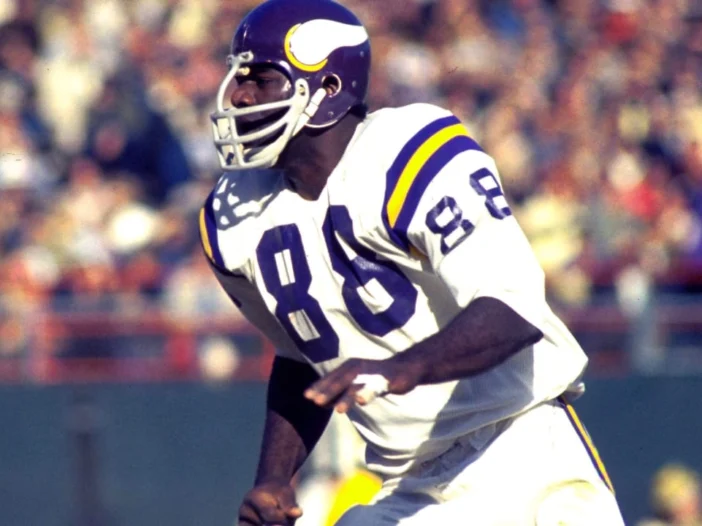
He was already a nine-time Pro Bowler and the first defensive player in NFL history to win the NFL Most Valuable Player award, and he was studying for his law school finals at the same time. Alan Page, born August 7, 1945, in Canton, Ohio, is one of the most astonishing figures in the history of American public life. This Alan Page biography covers everything: the legendary NFL career, the ground-breaking legal career, the education foundation he and his wife built from scratch, and the speaking legacy that continues to inspire audiences across the country. Few lives in the 20th century told a richer story about what discipline, intellect, and a genuine sense of civic duty can accomplish.
Quick Facts About Alan Page
| Detail | Information |
| Date of Birth | August 7, 1945 |
| Birthplace | Canton, Ohio |
| Nationality | American |
| Education | University of Notre Dame (BA, 1967); University of Minnesota Law School (JD, 1978) |
| Estimated Net Worth | $5 million |
| Spouse | Diane Sims Page (married 1973; deceased 2018) |
| Children | 4, Nina, Georgi, Justin, and Kamie |
| Occupation | Retired NFL Player; Retired Minnesota Supreme Court Justice; Author; Public Speaker |
Early Life and Background
Alan Page grew up in Canton, Ohio, a city that happens to be home to the Pro Football Hall of Fame, a fact that would become one of the more poetic footnotes of his life. He was raised in a working-class family that instilled in him an ethos of hard work and responsibility from a young age.
He attended Canton Central Catholic High School, where he distinguished himself as a standout football player. His athleticism was unmistakable, but so was something else: a seriousness of purpose that set him apart from his peers.
Page earned a football scholarship to the University of Notre Dame, arriving in South Bend, Indiana in 1963. That decision would change his life, and, eventually, American football, forever.

Career Beginnings: Notre Dame and the 1966 National Championship
At Notre Dame, Page developed into one of the most feared defensive linemen in college football. He was a key figure on the 1966 Notre Dame Fighting Irish football team, which finished the season undefeated and claimed the national championship, one of the most celebrated teams in the program’s storied history.
Page earned consensus All-American honours, cementing his reputation as the best defensive college player in the country. He was powerful, fast, and technically sophisticated, a combination that made him nearly impossible to block.
The Minnesota Vikings recognized exactly what they were getting. They selected Page in the first round of the 1967 NFL Draft, 15th overall. He would not disappoint them.
Major NFL Career Highlights
The Purple People Eaters
Page’s arrival in Minnesota coincided with the assembly of one of the most dominant defensive units in NFL history: the Purple People Eaters. The group, featuring Page, Carl Eller, Gary Larsen, and Jim Marshall, terrorized offenses throughout the late 1960s and 1970s.
Page played 15 seasons in professional football:
- Minnesota Vikings, 1967 to 1978
- Chicago Bears, 1978 to 1981
His career statistics are staggering:
- 173 unofficial sacks
- 23 fumble recoveries
- 28 blocked kicks
- 9 Pro Bowl selections
- 4× NFC Defensive Player of the Year
The NFL MVP, A Historic First
In 1971, Alan Page did something no defensive player had ever done before: he won the NFL Most Valuable Player Award. The AP, the Sporting News, and multiple other outlets gave him the honour in the same season.
That was not a formality. Defensive players are evaluated differently than quarterbacks and running backs, who accumulate visible statistics every week. For Page to win the MVP, the impact of his presence had to be so overwhelming, so fundamentally game-changing, that voters had no honest choice but to give it to him. They didn’t.
Four Super Bowl Appearances
The Vikings reached four Super Bowls during Page’s career, Super Bowl IV (January 1970), Super Bowl VIII (January 1974), Super Bowl IX (January 1975), and Super Bowl XI (January 1977). Though the team never captured the Lombardi Trophy, their dynasty remains one of the most formidable in the NFC’s history.
Pro Football Hall of Fame
Page was inducted into the Pro Football Hall of Fame in 1988, the same year he and his wife Diane founded the Page Education Foundation. Remarkably, he is believed to be the only person in NFL history who both worked on the physical construction of the Pro Football Hall of Fame as a young man in Canton and later was inducted into it. The symmetry is almost too perfect.
Going to Law School While Playing in the NFL
This is where Alan Page’s story departs from every standard athlete biography.
In 1975, while still an active starting defensive tackle for the Minnesota Vikings, while still one of the most physically dominant players in professional football, Page enrolled at the University of Minnesota Law School. He was 29 years old.
He attended classes during the offseason, studied during road trips, and balanced the intellectual demands of a law degree with the physical demands of playing in the NFL. He received his Juris Doctor in 1978, the same year he was still suiting up for the Vikings.
The discipline required to accomplish this is almost beyond comprehension. It stands as one of the most extraordinary feats of intellectual commitment in the history of American professional sports.
Legal Career and the Minnesota Supreme Court
After retiring from football, Page moved directly into full-time legal practice. His legal career unfolded methodically and impressively:
- Private practice at the Minneapolis law firm Lindquist & Vennum
- Special Assistant Attorney General for the State of Minnesota
- Assistant Attorney General for the State of Minnesota
Then came the moment that permanently secured his place in American history. In 1992, Alan Page was elected to the Minnesota Supreme Court, becoming the first African American to serve on that court in the state’s history.
He was not appointed. He ran. He won.
Page was reflected to the Minnesota Supreme Court in 1998, 2004, and 2010. He served as an Associate Justice until 2015, when Minnesota’s mandatory judicial retirement age of 70 required him to step down after 22 years on the bench.
His judicial opinions were known for their clarity, their moral seriousness, and their deep attention to the realities of people, not just the mechanics of legal theory.
The Page Education Foundation
In 1988, on the day of his induction into the Pro Football Hall of Fame, Alan Page and his wife Diane Sims Page announced the founding of the Page Education Foundation.
The foundation’s model is elegant and thoughtfully designed:
- Grants are awarded to Minnesota students of colour to help fund post-secondary education
- In exchange, recipients commit to 50 hours of community mentoring service, working with younger students
- The program creates a chain of civic investment, each grant recipient becomes a mentor, reinforcing the idea that education is a community responsibility
As of recent reporting, the foundation has supported thousands of students across Minnesota. It is widely considered one of the most intelligently structured athlete-founded education non-profits in American history.
Alan Page as a Public Speaker
Alan Page brings to the stage something most speakers cannot claim: he has actually lived two full careers at the highest possible level in two entirely different professions. That credibility is impossible to manufacture.
His speaking topics include:
- Education as the great equalizer, the foundational argument of his post-football life
- Leadership and accountability, drawn from both the defensive huddle and the judicial chamber
- Civic duty and service, what it means to give back at a structural, not just charitable, level
- Overcoming low expectations, his own story of not being seen as “the smart one”
- Building a second career of equal significance, a message of particular resonance for retiring athletes and mid-career professionals
Page is regularly booked for:
- Education conferences and university commencements
- Legal forums and bar association events
- NFL alumni and corporate leadership programs
- Civil rights organizations and MLK Day commemorations
His Alan Page speaking topics consistently focus on the idea that talent without discipline is wasted, and that service to community is not optional, it is the point.
Alan Page Net Worth 2026
Alan Page’s estimated net worth is $5 million, reflecting a lifetime of exceptional achievement across multiple high-earning fields.
His income sources include:
- NFL career earnings from 15 seasons across two franchises (1967–1981)
- 22 years of judicial salary as an Associate Justice of the Minnesota Supreme Court
- Public speaking fees from a career as a sought-after keynote speaker
- Children’s book royalties, Page has published four children’s books, including the Alan Page co-authored picture book Alan and His Perfectly Pointy Impossibly Perpendicular Pinky, written with his daughter Kamie
- Foundation leadership, while the Page Education Foundation is a non-profit, his association with it amplifies his speaking and media opportunities
Page has never been known as a flashy wealth accumulator. His lifestyle has been characterized by discipline, marathon running, and a deep focus on legacy over luxury.
Personal Life
Alan Page married Diane Sims Page in 1973. Together they raised four children: Nina, Georgi, Justin, and Kamie. Diane was a co-founder of the Page Education Foundation and the anchor of his personal life for 45 years. She passed away in 2018, a loss that Page has spoken about with characteristic quiet dignity.
Beyond football and law, Page has long been known as a dedicated long-distance runner. He completed the Edmund Fitzgerald 100km Ultramarathon in 1987, a detail that says almost everything you need to know about his relationship with physical and mental endurance.
He has spoken openly about his Christian faith and his belief that individual success carries an obligation to the community. His values, discipline, service, intellectual humility, have been consistent from his earliest years in Canton to his final day on the Minnesota Supreme Court bench.
One final, remarkable fact: Alan Page was awarded the Presidential Medal of Freedom in 2018, America’s highest civilian honour, recognizing both his athletic legacy and his contributions to justice and education. President Donald Trump awarded the medal in a White House ceremony. It was a bipartisan acknowledgment of a life that simply could not be argued with.
Alan Page Best Quotes
On education:
“Education is the key. It is the one thing that can open all other doors, and I’ve never seen a door it couldn’t open given enough time.”, Spoken at a Page Education Foundation event.
On his dual career:
“Football was something I did. Law was something I became.”, Quoted in multiple interviews about his transition from the NFL to the courtroom.
On service:
“I’ve come to believe that giving back isn’t something you do when you have enough left over. It’s what you do first.”, From a commencement address.
On being the first African American on the Minnesota Supreme Court:
“I was aware of the history. I was more aware of the work.”, Recalled in a 2015 interview at the time of his retirement from the court.
On the NFL MVP award:
“Winning that award meant the game was paying attention to what defensive players do. That mattered.”, ESPN interview, 2000s.
On his wife Diane:
“She made everything possible. The foundation, the law degree, all of it, Diane is threaded through every part of it.”, From remarks at a Page Education Foundation gala.
On Canton and his origins:
“Growing up in the city that built the Hall of Fame, that had to mean something. I decided it meant I had to be worth the city.”, Various speaking engagements.
On retirement from the court:
“I leave with no unfinished business. That’s the best thing a judge can say.”, Retirement statement, 2015.
Frequently Asked Questions
Alan Page is a retired NFL defensive tackle, former Minnesota Supreme Court Justice, author, and public speaker. Born on August 7, 1945, in Canton, Ohio, he played 15 seasons in the NFL and became the first defensive player in league history to win the NFL MVP award, in 1971. He later earned a law degree while still playing and was elected to the Minnesota Supreme Court in 1992, serving until 2015.
Yes. Alan Page was elected to the Minnesota Supreme Court in 1992, becoming the first African American Justice in the court’s history. He served as an Associate Justice for 22 years, winning reflection in 1998, 2004, and 2010. He retired in 2015 at age 70, as required by Minnesota’s mandatory judicial retirement law. His judicial career is considered as distinguished as his NFL career.
Alan Page won the NFL Most Valuable Player Award in 1971, the first defensive player in league history to receive that honour. He was also named to the Pro Bowl nine times, won the NFC Defensive Player of the Year award four times, appeared in four Super Bowls with the Minnesota Vikings, and was inducted into the Pro Football Hall of Fame in 1988. He played for both the Vikings and the Chicago Bears across 15 professional seasons.
Alan Page’s estimated net worth is approximately $5 million. This reflects earnings from his 15-year NFL career, a 22-year judicial career on the Minnesota Supreme Court, public speaking fees, royalties from his four children’s books, and his high-profile role as an advocate and foundation leader. Page has not been publicly associated with major commercial endorsements or luxury spending; his wealth is the product of two long, distinguished careers.
Alan Page’s speaking topics center on education, leadership, civic duty, and service. He draws on his unique experience as both an NFL Hall of Famer and a Supreme Court Justice to discuss overcoming low expectations, building a second career, and the responsibility that comes with success. He is frequently booked for education conferences, legal forums, civil rights events, and corporate leadership programs across the United States.
Conclusion
The Alan Page biography is, at its core, a story about refusing to accept the ceiling that others build above you. He was the best defensive player of his era in professional football, and that was not enough for him. He went to law school while playing in the NFL, became the first Black Justice on the Minnesota Supreme Court, founded an education non-profit that has changed thousands of young lives, and received the Presidential Medal of Freedom. Few American public figures have been great in two fields simultaneously. Alan Page was great in two fields consecutively, deliberately, and with full knowledge of exactly what he was doing. His legacy is as durable as the Hall of Fame building, he once helped construct.
Leave a Reply