
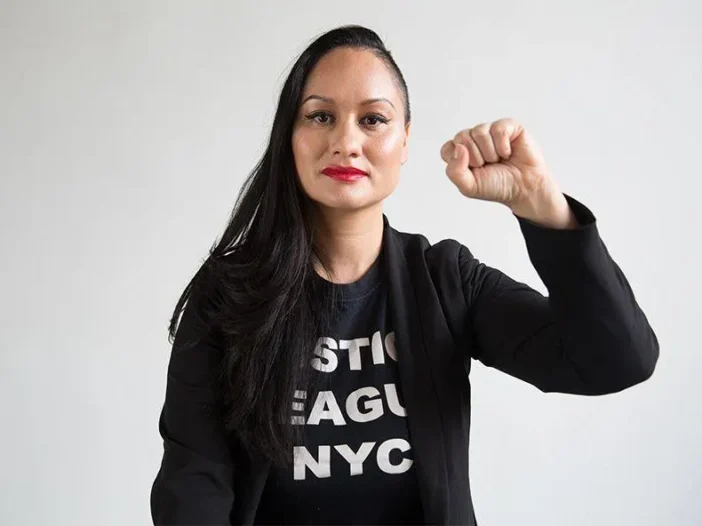
Carmen Perez has spent her career building the infrastructure of social justice, from co-organizing the historic 2017 Women’s March that drew an estimated 4 million people worldwide, to serving as national co-chair of March for Our Lives, to leading The Gathering for Justice, the nonprofit founded by music legend and activist Harry Belafonte. Few organizers of her generation have touched as many consequential movements simultaneously. A Chicana raised in Santa Cruz, California, Perez turned personal pain, including a devastating encounter with the criminal justice system, into a life’s calling rooted in equity, healing, and collective power. This complete Carmen Perez biography covers her early life, her path to national organizing, her major career milestones, her work as a speaker and CEO, her estimated net worth in 2026, and the values that drive everything she does.
Quick Facts About Carmen Perez
| Category | Details |
| Full Name | Carmen Perez-Jordan |
| Nationality | American (Chicana/Latina) |
| Birthplace | Santa Cruz, California, USA |
| Education | University of California, Santa Cruz (UC Santa Cruz) |
| Occupation | CEO, The Gathering for Justice; Co-Organizer, Women’s March; Co-Chair, March for Our Lives; Public Speaker; Author |
| Spouse/Partner | Married |
| Known For | 2017 Women’s March, March for Our Lives, The Gathering for Justice |
| Estimated Net Worth (2026) | ~$2 million |
| Social Media | Active on Instagram and X (formerly Twitter) as @syrcarmenjperez |
Early Life and Background
Carmen Perez grew up in Santa Cruz, California, embedded in a tight-knit Chicana community shaped by deep cultural roots, Catholic faith, and a strong ethic of collective care. She was raised in a working-class household where family and community were inseparable, values that would later become the bedrock of her organizing philosophy.
Her trajectory into activism was not simply ideological, it was personal. The murder of her sister and her own proximity to the criminal justice system as a young person exposed Perez to the failures of a system that too often punishes rather than heals communities of color. That experience did not break her; it focused her.
Perez went on to attend the University of California, Santa Cruz, where she deepened her understanding of social movements, race, gender, and systemic inequity. It was there that the intellectual framework for her life’s work began to take shape. Her academic foundation, combined with lived experience on the ground in her community, gave her a rare dual fluency, in both the language of scholarship and the work of organizing.

Career Beginnings
After graduating from UC Santa Cruz, Perez began working directly with young people caught in the web of the juvenile and criminal justice system. She took on youth advocacy roles in California, running programs aimed at rehabilitation, mentorship, and community reintegration rather than punishment.
This early work brought her into the orbit of The Gathering for Justice, the New York-based nonprofit founded by Harry Belafonte, the legendary singer, actor, and lifelong human rights activist. Belafonte’s organization had spent decades building a movement grounded in the belief that juvenile justice reform and racial equity are inseparable causes.
Perez impressed Belafonte and the organization’s leadership with her commitment and her ability to connect across generations, cultures, and communities. She climbed through the ranks of The Gathering for Justice, eventually becoming its Executive Director and later CEO, a position that would become her home base for some of the most consequential organizing of the 21st century.
Major Career Highlights
The Gathering for Justice
As CEO of The Gathering for Justice, Perez leads an organization that stands at the intersection of juvenile justice reform, community safety, and racial equity. Founded by Harry Belafonte with the conviction that “there will be no peace without justice,” the organization works to end child incarceration and dismantle the systems that funnel young people, disproportionately Black and Brown youth, into prisons rather than into futures.
Under Perez’s leadership, The Gathering for Justice has expanded its national reach, deepened its coalition partnerships, and produced some of the country’s most effective grassroots leaders. The organization’s Justice League NYC initiative has been particularly visible, staging direct actions and amplifying demands for police accountability and criminal justice reform.
Women’s March 2017, Co-Organizer
On January 21, 2017, the day after the inauguration of President Donald Trump, an estimated 4.7 million people marched across the United States, and millions more joined globally, in what became the single largest one-day protest in American history.
Carmen Perez was one of four national co-organizers who made it happen, alongside Linda Sarsour, Tamika Mallory, and Bob Bland. Working under intense public scrutiny and a compressed timeline, the team assembled one of the most logistically complex demonstrations ever organized, uniting women and allies across racial, economic, and generational lines.
Perez’s specific contribution was rooted in her expertise in cross-cultural coalition building. She brought the lessons of grassroots community organizing to a moment that could easily have dissolved into factionalism. Her presence ensured that the voices of women of color were not a footnote to the march, they were central to its identity and its demands.
March for Our Lives, National Co-Chair
When 17 students and staff were killed at Marjory Stoneman Douglas High School in Parkland, Florida, on February 14, 2018, survivors launched one of the most energized youth-led movements in a generation. The result was March for Our Lives, a national mobilization for gun violence prevention that brought hundreds of thousands of people to Washington, D.C. and cities across the country on March 24, 2018.
Carmen Perez served as national co-chair of March for Our Lives, bringing her organizational infrastructure, her relationships with community leaders across the country, and her deep experience managing large-scale mobilizations to a movement powered largely by first-time activists. Her role helped ensure the march’s demands were connected to a broader conversation about community safety, systemic racism, and the over-policing of communities of color, not just school shootings.
Author and Media Presence
Perez has contributed to national conversations through writing, media appearances, and advocacy campaigns. She has been featured in Time Magazine, The New York Times, NBC News, CNN, and numerous other outlets covering social movements and racial justice. Her voice has helped shape the public narrative around what it means to build a movement that is genuinely intersectional, one that refuses to separate the fight against gun violence from the fight against mass incarceration, or the march for women’s rights from the demand for racial justice.
Carmen Perez as a Public Speaker
Carmen Perez is one of the most sought-after social justice speakers in the country, booked by universities, nonprofit organizations, corporate DEI teams, government agencies, and social work conferences alike. Her speaking style combines the urgency of lived experience with the strategic clarity of a master organizer, she does not lecture; she moves people.
Carmen Perez speaking topics include:
- Mass organizing and movement building, how to build campaigns that last and coalitions that hold
- Juvenile and criminal justice reform, dismantling the school-to-prison pipeline, restorative justice, community-based alternatives to incarceration
- Chicana identity and activism, the specific experience of Latina women in progressive movements, and the power of cultural rootedness in organizing
- Intersectionality in the movement for racial and gender justice, why single-issue organizing often fails, and how to build across difference
- Building cross-cultural coalitions, lessons from the Women’s March and March for Our Lives
- Leadership development and healing justice, the internal work of sustaining a movement without burning out its people
- DEI and corporate responsibility, what genuine equity work looks like inside institutions
Perez is particularly popular on college and university campuses, where her biography and her work speak directly to student activists grappling with how to turn outrage into organized power. She is consistently booked for MLK Day events, Women’s History Month programming, Hispanic Heritage Month, and social work and public health conferences.
Carmen Perez Net Worth 2026
As of 2026, Carmen Perez’s estimated net worth is approximately $2 million. That figure reflects multiple income streams built over more than two decades of leadership in the nonprofit, advocacy, and speaking sectors.
Her primary income sources include:
- CEO salary at The Gathering for Justice, as the head of a nationally recognized nonprofit, Perez commands a senior executive compensation package
- Professional speaking fees, top-tier social justice speakers with Perez’s national profile typically earn $15,000–$30,000 per engagement, with premium fees for corporate and university bookings
- Consulting and advisory roles, her expertise in movement strategy and coalition building is sought by foundations, campaigns, and civic organizations
- Book deals and media contributions, authorship and media appearances provide additional revenue streams
- Board and advisory positions, affiliations with mission-aligned organizations in the social justice and philanthropic sectors
It is worth noting that Perez’s wealth, while meaningful, is modest compared to peers who have taken more commercial paths, a reflection of her deliberate choice to remain grounded in nonprofit and community work throughout her career.
Personal Life
Carmen Perez is based in New York City, where The Gathering for Justice is headquartered. New York’s dense network of social justice organizations, movement lawyers, labor unions, and community activists makes it a fitting home base for her work.
Those who know and work with Perez consistently describe her as someone who brings warmth, humor, and humanity to the heavy work of social justice. She does not perform seriousness, she brings joy into the room as a deliberate organizing strategy, believing that sustainable movements are built on love and community, not just anger and urgency.
Faith and spirituality play a meaningful role in her life and in her framework for justice. Her Chicana Catholic roots are not incidental to her organizing, they are woven into her understanding of community, sacrifice, dignity, and the long arc of justice.
Perez is married and keeps significant aspects of her personal family life private, a common boundary for activists who face public scrutiny and online hostility. She has spoken publicly about the importance of protecting her inner circle as a form of self-preservation and sustainability in long-term movement work.
Carmen Perez Best Quotes
On building movements:
“Organizing is not about one person. It is about building power with people, and that means showing up even when it’s hard, especially when it’s hard.” Perez has used variations of this framing in campus talks and conference keynotes to push back against the cult of the individual leader in activism.
On the Women’s March:
“We didn’t just organize a march. We organized a moment that became a movement, and the difference between those two things is the work that happens after.” Said in the weeks following January 21, 2017, as Perez and her co-organizers faced both celebration and criticism.
On intersectionality:
“You cannot fight for women’s rights and ignore the women who are being locked up. You cannot fight gun violence and ignore the guns that the state is pointing at Black and Brown communities.” A signature framing Perez deploys to challenge audiences to see justice as whole and interconnected.
On her Chicana identity:
“My culture is not a footnote to my activism. It is the source of it, the stories, the faith, the resilience, the love. All of it.” From a keynote address at a Hispanic Heritage Month event.
On young people:
“Every generation that rises up does so on the shoulders of everyone who came before them. My job is to make sure those young people know they are not starting from scratch, they are continuing.” Said at a March for Our Lives leadership convening.
On Harry Belafonte’s legacy:
“Harry taught me that the artist and the activist are the same person, someone who refuses to look away from the truth of what is happening to people.” From a tribute statement following Belafonte’s passing in April 2023.
On healing justice:
“We cannot build a movement out of broken people. The revolution has to include taking care of ourselves and each other, that is not a luxury. That is strategy.” A central theme in Perez’s speaking work on sustaining long-term organizing.
On her personal history:
“The system that failed my family and my community is the same system I have spent my life trying to change. My grief did not make me retreat. It made me organize.” From a personal essay on her path to activism.
Frequently Asked Questions
Carmen Perez, also known as Carmen Perez-Jordan, is a Chicana activist, nonprofit CEO, and national organizer from Santa Cruz, California. She is CEO of The Gathering for Justice, co-organizer of the 2017 Women’s March, and national co-chair of March for Our Lives. She is one of the most influential social justice movement builders of her generation and a prominent public speaker on criminal justice, racial equity, and coalition organizing.
Carmen Perez is best known for co-organizing the 2017 Women’s March, the largest single-day protest in American history, with an estimated 4.7 million participants in the U.S. alone. She was one of four national co-organizers alongside Linda Sarsour, Tamika Mallory, and Bob Bland. She is also nationally recognized for her role as co-chair of March for Our Lives, the 2018-gun violence prevention march launched by Parkland survivors.
The Gathering for Justice is a New York-based nonprofit organization founded by legendary entertainer and activist Harry Belafonte in 2005. It works to end child incarceration and dismantle the systems that criminalize communities of color. Carmen Perez serves as its CEO. The organization’s initiatives include Justice League NYC, which advocates for police accountability and criminal justice reform at the local, state, and federal levels.
Carmen Perez’s estimated net worth in 2026 is approximately $2 million. Her wealth comes from multiple sources: her CEO compensation at The Gathering for Justice, professional speaking fees (typically $15,000–$30,000 per engagement), consulting and advisory work, and media and publishing contributions. Her net worth reflects a career that has prioritized community impact over commercial opportunity, remaining grounded in nonprofit and social justice work.
Carmen Perez speaks on mass organizing and movement building, juvenile and criminal justice reform, Chicana identity and leadership, intersectionality in racial and gender justice movements, and cross-cultural coalition building. She is frequently booked by universities, racial justice organizations, corporate DEI programs, and social work conferences. Her speaking style is described as urgent, warm, and deeply practical, rooted in decades of on-the-ground organizing experience.
Conclusion
The Carmen Perez biography is, at its core, a story about what happens when personal pain is transformed into collective purpose. From the streets of Santa Cruz to the steps of the U.S. Capitol, Perez has helped architect some of the most consequential social movements of the 21st century, the Women’s March, March for Our Lives, and a decade of work at The Gathering for Justice. As a speaker, a CEO, and a cultural voice, she continues to shape the conversation about what justice looks like in America. Whether you are a student activist, a nonprofit leader, or simply someone trying to understand the landscape of modern movements, the story of Carmen Perez offers both inspiration and a practical roadmap.
Leave a Reply