
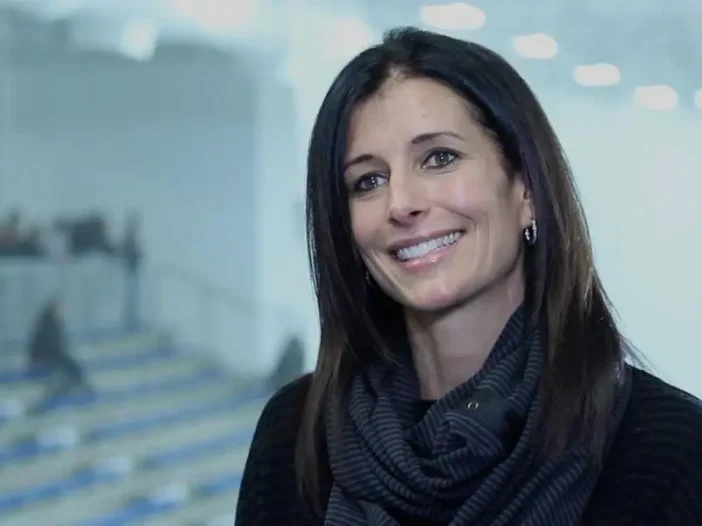
On September 23, 1992, Manon Rhéaume skated onto the ice at the Florida State Fairgrounds and changed professional sports forever, becoming the first and only woman ever to play in an NHL game. Suiting up for the Tampa Bay Lightning in a preseason matchup against the St. Louis Blues, the fearless Quebec-born goaltender shattered the most unbreakable barrier in professional hockey.
Before that moment, no woman had come close. After it, nothing in women’s hockey would ever be the same.
This Manon Rheaume biography covers everything: her childhood on frozen backyard rinks in Quebec, her path into men’s professional hockey, her decorated international career with Team Canada, her life after the game, and why she continues to inspire athletes, and leaders, around the world.
Quick Facts About Manon Rhéaume
| Detail | Information |
| Date of Birth | February 24, 1972 |
| Birthplace | Lac Beauport, Quebec, Canada |
| Nationality | Canadian |
| Height | 5’7″ |
| Net Worth (Est.) | ~$2 million |
| Spouse/Partner | Divorced (formerly Gerry St. Cyr) |
| Children | 2 sons, Dylan St. Cyr, Dakoda Rhéaume-Mullen |
| Occupation | Former Professional Goaltender, Hockey Analyst, Foundation Founder, Public Speaker |
Early Life and Background: Hockey in the Blood
Manon Rhéaume was born into a hockey family in Lac Beauport, Quebec, a small community tucked into the hills just north of Quebec City. Her father, Pierre Rhéaume, was a local hockey coach, and the sport was woven into the fabric of family life from her earliest years.
The Rhéaume family had a backyard rink, and Manon spent countless winter hours out there, developing the instincts and reflexes that would one day make hockey history. Her brothers played the game too, and she simply joined them, no one told her she couldn’t.
By the time she was 11 years old, Rhéaume had already done something remarkable: in 1984, she became the first girl to compete in the Quebec International Pee-Wee Hockey Tournament, one of the most prestigious youth hockey tournaments in the world. It was a preview of everything to come.
She grew up playing on boys’ teams, never treating gender as an obstacle. Her father’s coaching background gave her access, yes, but her talent earned her the respect.
Career Beginnings: Breaking into Men’s Hockey
Rhéaume’s path into professional hockey didn’t begin with the NHL. It began with a bold step into men’s junior hockey that few could have imagined.
In 1991, she played 17 minutes in the Quebec Major Junior Hockey League (QMJHL), suiting up for the Trois-Rivières Draveurs, becoming the first woman ever to play in a major junior hockey league. She allowed two goals in that appearance, but the performance was enough to capture attention at the highest levels of the sport.
That performance caught the eye of Phil Esposito, the Hall of Fame center who was then serving as General Manager of the newly formed Tampa Bay Lightning. Esposito invited Rhéaume to the Lightning’s training camp in September 1992.
Some called it a publicity stunt. Rhéaume didn’t care. She showed up and competed.
Major Career Highlights
The Historic NHL Game, September 23, 1992
The night of September 23, 1992 belongs permanently to hockey history. Rhéaume took the ice at the Florida State Fairgrounds in Tampa, suiting up for the Tampa Bay Lightning in a preseason game against the St. Louis Blues.
She played one full period. She faced 9 shots and allowed 2 goals, a performance that, in context, was entirely respectable at the professional level.
More than the stats, it was the act itself. No woman, before or since, has played in an NHL game. Rhéaume’s name stands alone in that record.
After training camp, she was signed to a minor league deal with the Atlanta Knights of the International Hockey League (IHL).
Minor League Career (1992–1997)
Rhéaume didn’t retire after her historic NHL appearance. She kept playing, professionally, against men, for five more years.
Her minor league career spanned 24 professional games across 7 teams, including:
- Atlanta Knights (IHL)
- Nashville Knights (ECHL)
- Las Vegas Thunder (IHL)
- Reno Renegades (WCHL)
- Tallahassee Tiger Sharks (ECHL)
- Mississippi Sea Wolves (ECHL)
- Baton Rouge Kingfish (ECHL)
She wasn’t a token presence. She was a working professional goaltender competing in men’s leagues, game after game, year after year.
International Career with Team Canada
While her professional career was a trailblazing experiment, Rhéaume’s international career was dominant by any measure.
She represented Canada’s national women’s hockey team with consistent excellence:
- Gold medal, IIHF Women’s World Championship, 1992
- Gold medal, IIHF Women’s World Championship, 1994
- Silver medal, 1998 Nagano Winter Olympics (the first Olympic Games to include women’s hockey)
- Named to the All-Star team at both World Championship appearances
The 1998 Nagano Olympics was a milestone not just for Rhéaume personally, but for the entire sport. Women’s hockey was making its Olympic debut, and Manon Rhéaume was one of its defining faces.
Manon Rhéaume as a Public Speaker
After her playing career ended, Rhéaume channeled her story into a new kind of impact: speaking.
Her biography is tailor-made for keynote audiences. She is one of the rare athletes who didn’t just compete at the highest level, she competed where women had literally never been allowed before. That experience translates into powerful, transferable lessons for any audience facing barriers, bias, or self-doubt.
Rhéaume is regularly booked for:
- Women’s leadership conferences
- Sports organizations and athletic departments
- Corporate diversity and inclusion events
- College athlete programs and university campuses
- Youth hockey development programs
Her speaking topics include:
- Breaking barriers in male-dominated industries
- Resilience and perseverance in the face of doubt
- Women in sports, then, now, and the road ahead
- Leadership as an outsider, how to earn respect without permission
- Believing in yourself when the world tells you no
Rhéaume’s message is never abstract. She can point to a specific night, September 23, 1992, when she walked into an arena that had never made room for her and played anyway. That kind of credibility doesn’t need embellishment.
Manon Rhéaume Net Worth 2026
Manon Rhéaume’s estimated net worth is approximately $2 million, built across multiple revenue streams over more than three decades in and around hockey.
Her wealth comes from several sources:
- Professional hockey career (1991–1997), playing fees from QMJHL appearance, NHL preseason, and multiple minor league teams
- Hockey broadcasting, work with RDS (French-language sports network in Quebec), including analysis and commentary
- Hockey operations, a role with the Los Angeles Kings in 2022, working in player development and scouting
- Public speaking fees, keynote appearances at corporate, sports, and academic events
- The Manon Rhéaume Foundation, a non-profit she founded to provide scholarships and support for young women in hockey and sports
Rhéaume has never chased celebrity. Her wealth reflects decades of consistent, disciplined involvement in the sport she loves, from every possible angle.
Personal Life
Manon Rhéaume has built a life deeply rooted in hockey, and in her children.
She was previously married to Gerry St. Cyr; the couple later divorced. Together they have a son, Dylan St. Cyr, who followed his mother’s footsteps between the pipes. Dylan played college hockey as a goaltender at Michigan State University, earning his own reputation in a family already defined by the position.
Her son Dakoda Rhéaume-Mullen played college hockey as a defenseman at the University of Michigan, two sons, two different Big Ten programs, one hockey family.
Rhéaume lives in Michigan, where she has remained closely connected to hockey development at all levels. She is known for keeping a low public profile outside of speaking engagements and hockey events, no reality TV, no tabloid drama, no celebrity lifestyle.
Her values are clear: hard work, honesty, and showing up for the people around you. Those aren’t PR talking points. They’re the values she actually played by.
Manon Rhéaume Best Quotes
1. On her historic NHL appearance:
“I didn’t think about being the first woman. I just thought about stopping pucks.”
Rhéaume has consistently deflected the historic weight of her NHL appearance, preferring to frame it as a hockey story, not a gender story.
2. On playing in men’s leagues:
“I had to prove myself every single day. Nobody was going to give me anything.”
This quote captures the competitive reality Rhéaume faced, not as an icon, but as a working goaltender trying to earn a spot.
3. On doors opening for women:
“When I stepped on that ice, I knew I was opening a door, not just for me, but for every girl who would pick up a hockey stick after me.”
Spoken at a women’s sports leadership event, reflecting on the long-term significance of her 1992 appearance.
4. On resilience:
“The people who told me I couldn’t play made me stronger. Doubt from others was fuel.”
A core theme in her speaking engagements, using external skepticism as internal motivation.
5. On women in sports:
“We’ve come so far, but the job isn’t done. Every generation of women has to fight for their place at the table.”
A recurring point in her keynote addresses on gender equity in athletics.
6. On her sons following her into hockey:
“Watching my boys play, that’s my favourite part of hockey now. I didn’t just love the game. I passed it on.”
Shared in a 2022 interview, reflecting on her family’s hockey legacy.
7. On what the NHL moment really meant:
“One period. Nine shots. Two goals. And 30 years of people still asking about it. That tells you something about what it meant.”
Rhéaume, reflecting with characteristic understatement on the enduring significance of September 23, 1992.
Frequently Asked Questions
Yes. On September 23, 1992, Manon Rhéaume became the first, and still the only, woman ever to play in an NHL game, suiting up for the Tampa Bay Lightning in a preseason contest against the St. Louis Blues. She played one period, faced nine shots, and allowed two goals. No woman has played in an NHL game before or since. Her place in hockey history is singular and permanent.
Manon Rhéaume’s estimated net worth is approximately $2 million. Her wealth was built across a professional playing career (1991–1997), French-language sports broadcasting for RDS, a hockey operations role with the Los Angeles Kings in 2022, public speaking fees, and leadership of the Manon Rhéaume Foundation, which supports young women in sports through scholarships and development programs.
After retiring from professional play, Rhéaume moved into broadcasting (working with the French sports network RDS), hockey operations (she joined the Los Angeles Kings in 2022), public speaking at corporate and sporting events, and philanthropic work through her foundation. She also remained deeply involved in hockey development and raised two sons who both played Division I college hockey.
Yes. Manon Rhéaume won a silver medal at the 1998 Nagano Winter Olympics, representing Canada in women’s ice hockey, the first time the sport was included in the Games. She also won two gold medals at the IIHF Women’s World Championship, in 1992 and 1994, and was named to the All-Star team at both tournaments.
Manon Rhéaume speaks on breaking barriers, resilience, women in sports, leadership under pressure, and believing in yourself against the odds. She is booked for women’s leadership conferences, sports organizations, corporate diversity events, and college athletic programs. Her keynote credibility is rooted in lived experience: she didn’t just talk about breaking barriers, she skated through one in front of a professional hockey crowd.
Conclusion
The Manon Rheaume biography is more than a hockey story, it’s a blueprint for doing what the world says is impossible. From frozen backyard rinks in Lac Beauport to the ice of an NHL arena, Rhéaume carved out a place no woman had ever held, and she held it with skill, composure, and quiet determination.
She remains the only woman in NHL history. She is an Olympic medallist. She is a broadcaster, an executive, a foundation founder, and a mother who raised two Division I college hockey players. She is, by any measure, one of the most consequential figures in the history of women’s sports.
Her story isn’t finished. And it still deserves to be told.
Leave a Reply